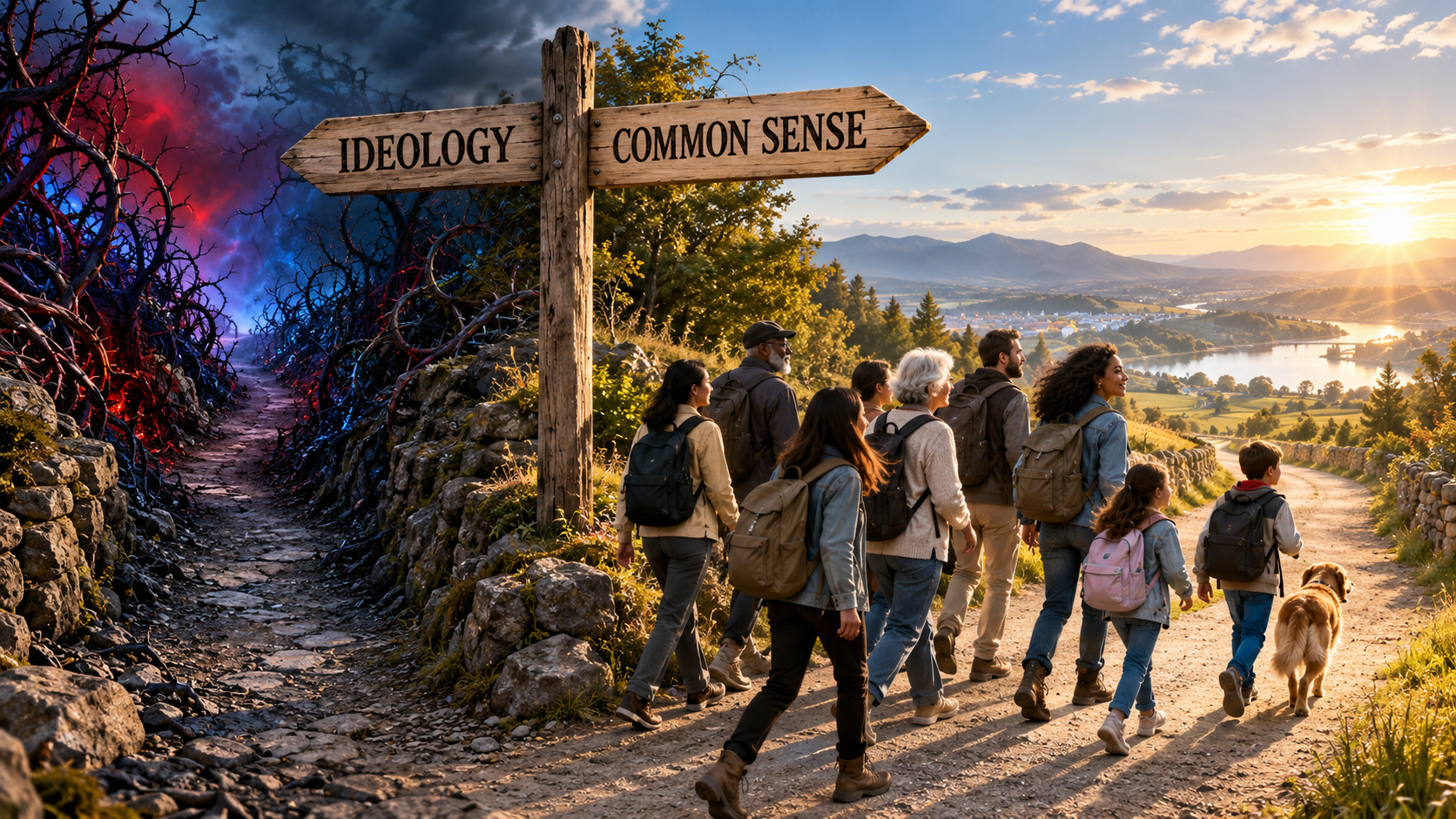
Common sense should help us pause and ask simple questions.
Does this make sense? What evidence supports it? What might happen next? Who will be affected? Is there a better way?
These questions are not complicated. They are the starting point for sound judgement. Yet public debate and everyday decision-making increasingly seem to bypass them. Ideological rhetoric is everywhere: people are urged to see events through a fixed set of beliefs, defend their side and dismiss those who think differently.
When that happens, it becomes harder to look beyond our own views. We stop asking whether an argument is sound and start asking whether it belongs to our side. We give more weight to claims that confirm what we already believe, and less to evidence or experience that might challenge us.
The result is visible in the problems we see today: division deepens, practical questions become loyalty tests, and people struggle to work together even when they share concerns about the outcomes.
The issue is not that everyone must agree on what is sensible. People bring different experiences, values and priorities. What seems obvious to one person may look very different to another. Common sense is not a substitute for evidence, expertise or careful thought.
But basic logic still matters. Claims should be examined. Decisions should be connected to their likely consequences. When the evidence changes, conclusions should be open to change too.
When belief becomes a boundary
Ideology can help people make sense of the world. It can reflect values, explain what someone believes is fair, and point towards the changes they want to see. The difficulty comes when an ideology becomes a boundary around what may be questioned.
Then disagreement is treated as proof of bad character. A question about whether a policy is working can be heard as an attack on everyone who supports it. A request for evidence can be dismissed as hostility. People may reject a useful idea because it came from someone they distrust, or excuse a poor outcome because it came from their own side.
This does not mean all positions are equally well supported, or that every argument deserves equal weight. It means we need to examine claims on their merits, consider the evidence and remain willing to hear from people whose experience differs from our own.
If we cannot do that, our views can become more important to us than the problems we say we want to solve.
When the questions disappear
Many of the problems people face are difficult and interconnected. Housing affects health, work and family life. Decisions about energy affect costs, industry and the environment. Changes in technology create opportunities alongside new risks.
There may be no easy answer. That makes clear thinking more necessary, not less.
Instead, discussion can become a contest of slogans, loyalties and assumptions. People are encouraged to choose a side before they have had a chance to understand the issue. Attention shifts from what is happening and what could improve it to who is right, who is wrong and which group deserves the blame.
When that happens, the original question gets lost. We spend more time defending positions than examining outcomes.
Common sense needs to be tested
Common sense can be wrong. Familiar ideas may reflect habit, prejudice or incomplete information. A confident majority can still misunderstand a problem. Restoring common-sense logic does not mean accepting the first answer that feels right.
It means being willing to test our thinking.
What do we know? What do we still need to find out? Which assumptions are we making? Who has been heard, and who has been left out? What would count as evidence that an approach is working? If it is not working, what should change?
These questions make disagreement more useful. They help people move beyond defending a position and towards understanding what is happening and what might improve it.
Looking beyond our own views does not require abandoning our principles. It asks us to consider whether our interpretation is complete, whether another person sees something we have missed, and whether the outcome matters more than winning the argument.
From frustration to participation
People often notice when something does not add up. They see a problem in their community, workplace or wider society. They may have experience that could help explain it, an idea worth exploring, or a practical offer to make.
But noticing a problem does not automatically give people a way to act on it. Too often, frustration stays private, or conversation ends with the same few people arguing in the same places.
We need ways for people to bring forward what matters, make it visible, hear different perspectives and organise contributions around possible outcomes. That is where participation can turn clear thinking into practical capability.
Ideas-Shared gives people a place to raise ambitions, ideas, problems, questions and solutions as activity listings. Others can discover them, consider their importance, share them, offer help, join a group or contribute to the work. Different activities can support a larger ambition, and people can take part in the ways that fit their abilities and circumstances.
The purpose is not to make every person think alike. It is to help people put their knowledge, experience and effort to use around things they care about—even when they do not begin from the same point of view.
A better question to ask
When something seems illogical, we can start by asking what is missing. Is the evidence unclear? Are important voices absent? Are people working towards different outcomes? Has a process become more important than the result it was meant to achieve? Are we rejecting an idea because it challenges our beliefs, or because it does not stand up to scrutiny?
Then we can decide what to do with what we learn. We might challenge an assumption, make others aware, press for something to stop, or work with others to create a better alternative.
Those steps begin with ordinary questions and a willingness to engage. They do not guarantee agreement or an immediate solution. They do give people a way to move from reaction towards considered action.
We may not be able to make every decision sensible. But we can restore the habit of asking whether it is. We can look beyond our own views, examine the evidence, listen to people affected and keep asking what outcome we are trying to achieve.
Common sense is not simply an answer. It is the discipline of asking the questions that help us find one – and staying open to the possibility that we may need to change our minds.
What no longer makes sense to you – and what could we do together to change it?
Choose the Next Step
Now things get interesting. Let’s look at the world as it is – and question some of the assumptions that shape how we respond.
- High fuel prices and instability in the Middle East. Why does progress towards stability remain so difficult? Which assumptions, interests or approaches keep the same problems in place? Why hasn’t this been sorted?
- Housing that many people struggle to afford. Do we assume the market will eventually provide enough homes for everyone? What evidence supports that – and what could be done differently? Why are we putting immigrants before our own people?
- Pressure on healthcare and public services. Are these problems simply unavoidable, or do the way services are funded, organised and prioritised contribute to them? What do the people who rely on them say? Or do we simply have too many people trying to utilise too few services?
- Political division and distrust. Have we come to believe that progress can only happen when one political side defeats another? What might change if we started with the outcomes people across those divides want? Do our politicians even know what good looks like?
- Immigration debates dominated by competing claims. Are we separating different issues – such as asylum, legal migration, irregular entry, integration and public service capacity – or treating them as one argument? What evidence would help us understand each one? And why are we penalising our own people who dare question the status quo?
- Young people struggling to find a first opportunity. Do employers, educators and policymakers assume someone else will prepare young people for work? What would help more people gain useful experience and a genuine start? And why do we think AI can help?
- Charities doing essential work while facing financial pressure. Do we assume charitable giving alone can sustain the work society depends on? What other sources of support, cooperation or funding could help? How do we rebalance the entire sector?
- The transition to more sustainable energy. Do we treat affordability, energy security and environmental impact as competing priorities? What would it take to address all three together? And why have successive Governments failed to tackle this properly?
- New technologies creating both opportunity and concern. Do we assume that innovation will automatically benefit everyone – or that risks mean progress should stop? Who gets to shape how these technologies are used? Have we lost our mind to tech?
- Problems that persist despite years of debate. Do we assume that more discussion, another policy announcement or a change of leader will be enough? How will we know whether anything has actually improved?
These questions do not have one simple answer. They are starting points: a way to look beyond familiar rhetoric, test our assumptions and hear what people with different experiences can see.
The next step is not more of the same. It’s humanity – ordinary people and organisations coming together, ditching ideological frames and reverting to common sense logic. Bring forward an ambition, idea, problem, question or solution. Explore what others have started, share a listing, vote on what deserves attention, or offer to help.