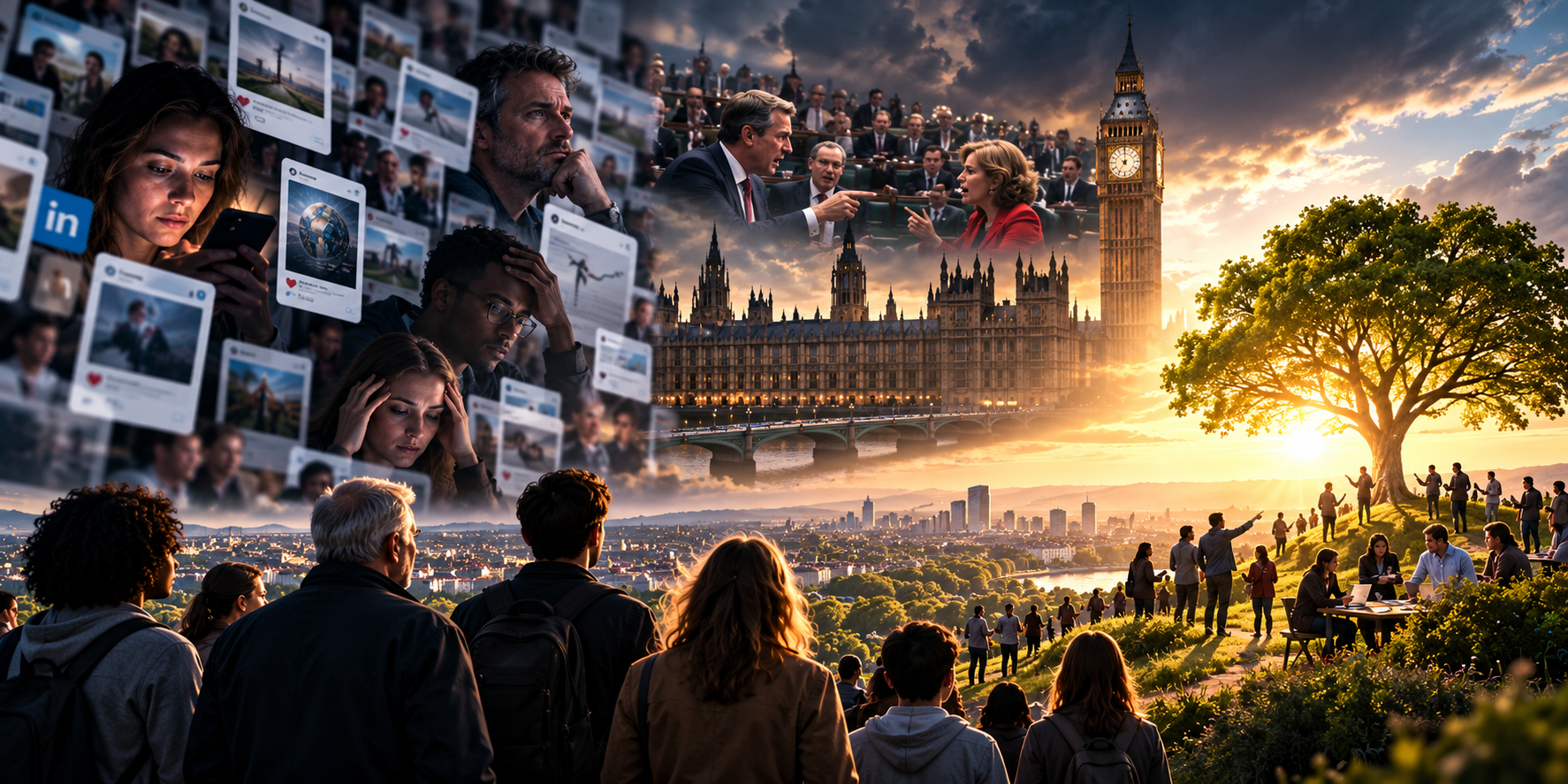
Every day, millions of people see the problems. Millions have ideas. Millions have something to contribute. Yet somehow, we keep going round in circles.
Open LinkedIn.
Scroll through the posts.
Interesting articles. Thought-provoking opinions. Important questions. Brilliant ideas. Frustrations. Solutions. Warnings about the future. People challenging the status quo.
Some of it is genuinely valuable.
But what happens to it?
You read something. Perhaps you like it. Perhaps you comment. Perhaps you share it.
Then you scroll.
Another post. Another opinion. Another problem. Another argument.
Yesterday’s important discussion disappears beneath today’s content. Tomorrow, something else takes its place.
Seen once. Discussed briefly. Largely forgotten.
Not because people don’t care. Not because the subjects aren’t important.
But because there is simply too much for any one person to absorb, organise, remember or act upon.
And because the systems we’ve built are extraordinarily good at generating attention, but remarkably poor at turning that attention into lasting progress.
Meanwhile, Look at the State of Politics
Look at the latest Budget.
Look at Parliament.
Look at the arguments, accusations, point-scoring, political theatre and endless attempts to prove that one side is right and the other is wrong.
Government versus opposition.
Left versus right.
One ideology versus another.
And somewhere in the middle are millions of ordinary people wondering whether anyone has remembered what all this is supposed to be about.
Housing. Healthcare. Education. Employment. Public services. Debt. Taxation. Infrastructure. Security. The environment. The cost of living. The future of our children.
These are not abstract political debating points.
They are real issues affecting real lives.
Yet so much of our collective energy is consumed by the argument rather than the outcome.
When did winning the argument become more important than solving the problem?
And perhaps an even more uncomfortable question:
Have we collectively lost sight of what governments, institutions, businesses and communities are actually supposed to achieve?
And What About Everyone Who Isn’t Even in the Conversation?
Not everyone uses LinkedIn.
Not everyone follows political debates.
Not everyone watches the Budget.
Not everyone reads newspapers, joins campaigns, attends meetings or engages with social media.
Millions of people simply get on with their lives.
They work. They raise families. They pay bills. They look after others. They try to make ends meet.
They experience the consequences of decisions without necessarily having much opportunity to influence them.
And even those who do engage often find themselves wondering whether their contribution made any difference.
We have more ways to communicate than at any point in human history.
Yet how many people genuinely feel they have a meaningful say in shaping the world around them?
Being able to express an opinion is not the same as being able to influence an outcome.
That distinction matters enormously.
What If We Stopped for a Moment and Did Something Different?
Imagine something.
What if, instead of endlessly reacting to whatever happens to dominate the headlines, we collectively started identifying the things that actually need attention?
Not just political issues.
Everything.
Personal challenges. Local problems. Community ambitions. Business inefficiencies. Social injustices. Scientific opportunities. Environmental concerns. Economic pressures. Ideas for doing things differently.
What if we could bring them together in one place?
Not to argue endlessly about who is to blame.
Not to promote one political party or ideology.
Not to compete for likes, followers or attention.
But to establish a shared understanding of what matters.
Then imagine we could all help prioritise those issues.
What is urgent?
What is important?
What affects the most people?
What can be resolved quickly?
What requires longer-term cooperation?
What should we stop doing?
What should we start doing?
What could we achieve if we combined our knowledge, capabilities, experience, resources and influence?
And crucially:
What can each of us actually do to help?
Imagine What Would Fall Out of That Tree
Some issues would require government action.
Others would need businesses to change their practices.
Some would be best addressed by charities, community organisations, professional bodies or local authorities.
Others might be resolved by a handful of people working together.
Some would need funding.
Some would need expertise.
Some would need volunteers.
Some would simply need somebody to ask the right question, challenge an assumption, share knowledge or connect people who would otherwise never meet.
Not every issue would command agreement.
Not every ambition would be achievable.
And not every priority would remain important forever.
But for once, we would have something we currently lack.
A living, organised picture of what people want to change, why it matters, how important they believe it is, and what is actually being done about it.
Instead of thousands of disconnected conversations, we could have thousands of connected opportunities for progress.
Instead of problems repeatedly disappearing from public attention, they could remain visible until resolved, superseded or consciously set aside.
Instead of everyone waiting for somebody else to act, people could find where their own contribution might make a difference.
This Is What Ideas-Shared Is About
Not another social media platform.
Not another place to accumulate followers.
Not another endless stream of posts competing for attention.
And certainly not another institution telling people what they should think.
Ideas-Shared exists to enable something fundamentally different.
To help people organise around what they want to achieve, rather than simply around who they are, who they follow or what they believe.
A place where individuals, communities, businesses and organisations can declare ambitions, raise issues, develop ideas, ask questions, challenge assumptions, offer solutions and contribute to the activities of others.
Where those activities can be shared, considered, prioritised and developed.
Where people can form groups, build teams, plan tasks, take action and track progress.
Where the objective is not simply to generate discussion, but to make something happen.
And where an activity doesn’t have to disappear because the news cycle has moved on.
It can remain.
It can evolve.
New people can join.
New activities can develop around it.
Its status can change as progress is made.
And even when completed, it can remain as a record of what was attempted, what was achieved and what others might learn.
That is a very different proposition from the world of endlessly disappearing content.
You Don’t Have to Agree. You Do Have to Decide Whether to Participate.
This is perhaps the most important point of all.
We don’t need eight billion people agreeing about everything.
That would be impossible.
We don’t need everyone becoming politically active.
We don’t need everyone spending hours online.
And we certainly don’t need everyone contributing to every issue.
What we need is the opportunity for people to participate in the things that matter to them.
Some will challenge assumptions.
Some will make others aware.
Some will work to stop what needs stopping.
Others will help co-create new realities.
Some might contribute an hour.
Others might contribute expertise developed over decades.
Some might simply identify a problem nobody else has recognised.
Every contribution has the potential to matter.
But unless there is somewhere for those contributions to connect, develop and become organised, much of that potential will continue to be lost.
Because the Alternative Is to Keep Drifting
Think about the last five years.
How many problems have you seen discussed repeatedly?
How many promises have you heard?
How many ideas have impressed you?
How many times have you thought, surely somebody must be doing something about this?
Now think about the next five years.
Will we still be having the same arguments?
Will we still be scrolling through the same frustrations?
Will the same problems continue to reappear under different headlines?
Will we continue to look towards governments, institutions and leaders, hoping that somebody somewhere will eventually sort things out?
Perhaps.
But it doesn’t have to be that way.
We have the technology.
We have the knowledge.
We have the experience.
We have the collective capability.
And we have billions of people with their own ambitions, ideas, concerns, skills and willingness to contribute.
What we haven’t had is a practical way to bring all of that together around the outcomes people want to achieve.
That is the missing layer Ideas-Shared is seeking to provide.
The Choice Is Ours
We can carry on watching.
Reading.
Reacting.
Arguing.
Scrolling.
Waiting.
Days become weeks.
Weeks become months.
Months become years.
And before we know it, another decade has passed.
Or we can begin doing something different.
We can identify what matters.
We can establish priorities.
We can connect people.
We can organise activities.
We can contribute.
We can take action.
And we can begin measuring progress by what actually changes, rather than how much attention something receives.
Nobody can promise that every ambition will succeed.
Nobody can guarantee that every problem will be solved.
But surely a world in which people can organise and participate in shaping outcomes is preferable to one in which so many simply watch events unfold.
Because ultimately, there are two possibilities.
You participate in shaping the world around you.
Or you leave it to others, and live with whatever happens.
And that choice doesn’t have to be made once.
It can be made today.
Tomorrow.
And every day thereafter.
The world doesn’t need another endless conversation.
It needs a way to turn our collective ambitions into collective progress.
That’s why we created Ideas-Shared.
Ideas-Shared Global Hub — Don’t Just Watch the World. Help Shape What Happens Next.