
From a Web of Websites to a Web of Activities
One Connecting Architecture. A World of Possibilities.
The World Wide Web transformed how humanity accesses information, communicates and connects. It gave individuals, businesses, communities and organisations unprecedented opportunities to establish their own digital presence and reach beyond traditional boundaries.
But the world remains fragmented.
Billions of people, millions of organisations, countless websites, digital platforms, communities and physical networks exist alongside one another. Each possesses knowledge, capabilities, resources, opportunities and ambitions.
Yet connecting those capabilities to the people who need them remains unnecessarily difficult, costly and inefficient.
People search, advertise, promote, network, navigate different systems and compete for attention. Valuable ideas go unnoticed. Problems remain unresolved. Opportunities are missed. Resources are underutilised.
What if there were a common architecture connecting them all — not around who they are or where they exist, but around what they want to achieve and what they can contribute?
That is the concept behind Ideas-Shared.
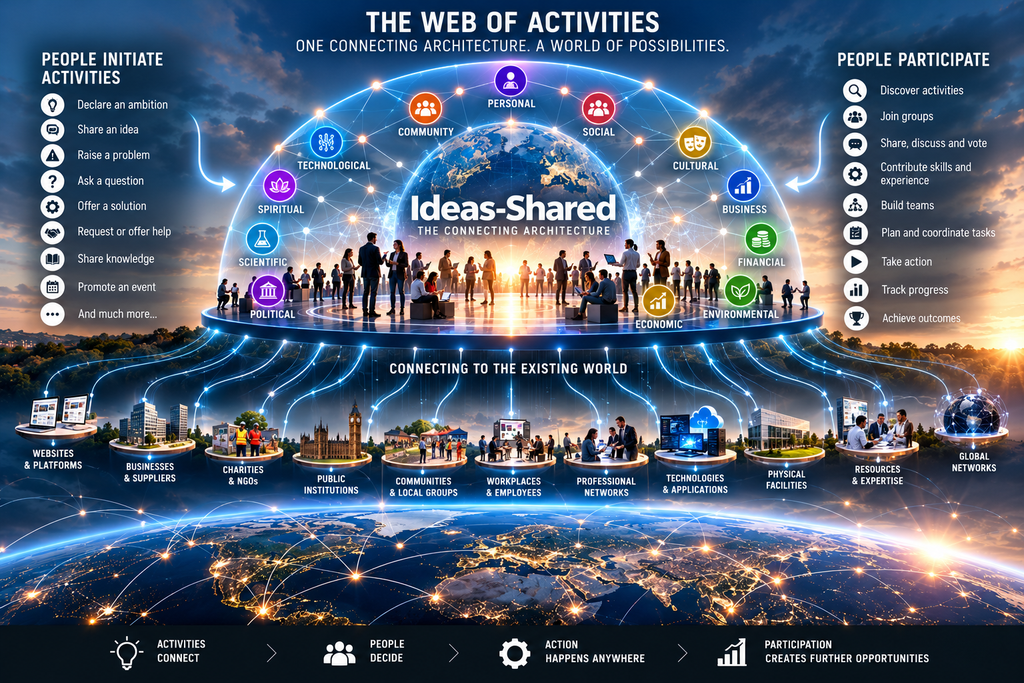
Introducing the Web of Activities
Ideas-Shared proposes an evolution in how people and organisations connect, participate and create value.
From a Web of Websites to a Web of Activities.
Rather than organising participation primarily around separate websites, platforms, institutions or audiences, Ideas-Shared introduces a common activity-based architecture.
An architecture through which any individual, informal group, organisation or part of an organisation can initiate something that matters and potentially engage the capabilities of people across the world.
An ambition. An idea. A problem. A question. A requirement. An opportunity. A solution. An offer of help.
Each can become an activity through which others discover, engage, contribute and participate.
The activity becomes the connecting point.
One person. One ambition. Potentially the whole world.
And the same opportunity exists for every participant.
One Doorway. One Connecting Architecture.
Ideas-Shared is not intended to replace the existing web.
Nor does it seek to replace organisations, institutions, communities, technologies or established ways of working.
Ideas-Shared is the doorway into a common connecting architecture that sits across the existing online and offline world.
Through that doorway, participants can make their ambitions, needs, capabilities, solutions and opportunities discoverable to others.
The architecture provides a common framework for initiating activities, attracting participation, establishing groups, coordinating contributions and recognising progress and outcomes.
Below that connecting layer remains the extraordinary diversity of the existing world.
Websites, applications, businesses, charities, public institutions, communities, workplaces, physical facilities, professional networks, technologies and resources all continue to exist and operate independently.
Ideas-Shared enables participants to connect with and draw upon them in pursuit of their activities.
The purpose is not to bring everything into Ideas-Shared. It is to make everything potentially more accessible and useful through Ideas-Shared.
Activities Connect. People Decide. Action Happens Anywhere.
Every activity represents an opportunity for people to come together around something they want to achieve, change, understand, offer or resolve.
Groups provide collection points for interested participants.
But participation does not have to remain within Ideas-Shared.
People can choose to collaborate using their own websites, systems, applications, communications tools, workplaces, meeting spaces and existing organisational arrangements.
They can work online, offline or through any combination of the two.
A community improvement activity might begin online and result in volunteers working together in a neighbourhood.
A business requirement might attract suppliers who subsequently negotiate and transact through their existing commercial systems.
A scientific question might connect researchers who collaborate through their universities and laboratories.
A charity initiative might mobilise volunteers, donors, organisations and physical resources across multiple locations.
An individual seeking assistance might connect with someone capable of helping them directly.
Ideas-Shared connects the opportunity. Participants decide how and where to realise it.
The architecture supports participation without requiring the world to abandon the systems, relationships and resources it already possesses.
Participants Are the Engines of Their Own Growth
The Web of Activities is designed around a fundamentally different growth model.
In conventional digital environments, platforms and organisations frequently depend upon continually attracting attention, producing content, advertising and promoting themselves.
Ideas-Shared introduces the possibility of growth generated through participation itself.
Participants initiate activities.
Activities create opportunities for others.
Others discover those opportunities and contribute knowledge, experience, capabilities, resources, relationships, influence or practical assistance.
Those contributions can generate solutions, outcomes, benefits and further opportunities.
New activities emerge. New participants become involved. New connections form.
Every participant can contribute to the growth and value of the network while pursuing their own ambitions.
An individual can be seeking assistance in one activity, offering expertise in another, volunteering in a third, purchasing a solution in a fourth and making decisions in a fifth.
The same applies to informal groups, businesses, charities, institutions and their constituent parts.
At sufficient scale, the network has the potential to become increasingly self-reinforcing.
Its value grows not simply because more people join, but because more capabilities, needs, solutions and opportunities become accessible to one another.
From Paying for Attention to Creating Value
Today’s commercial and digital economy devotes enormous resources to attracting attention.
Businesses advertise to find customers. Organisations promote themselves to attract supporters. Individuals compete for visibility. Suppliers invest in generating leads. Customers spend time searching for suitable solutions.
Much of this activity exists because those who need something and those capable of providing it are not easily connected.
The Web of Activities proposes a different approach.
Instead of continually promoting what we offer, make what we offer discoverable to those who need it.
A customer can register a requirement.
A supplier can offer a solution.
A business can showcase its capabilities.
An individual can request help.
A professional can share expertise.
A charity can seek volunteers or resources.
A community can identify a problem and invite contributions.
A decision-maker can discover an activity where their involvement could make a difference.
Rather than relying solely on promotional activity to generate awareness, participants can connect through their actual needs, offerings, ambitions and capabilities.
At scale, this could reduce unnecessary marketing expenditure, duplicated effort, search costs and missed opportunities.
Resources currently consumed in competing for attention could instead support innovation, service delivery, lower costs, greater productivity and improved outcomes.
The true value of an individual, organisation, product, service or solution is not how successfully it is promoted, but what it contributes and delivers.
Marketing may still have a role. But the architecture is designed to reduce dependence on marketing as the primary mechanism for connecting needs with capabilities.
A Universal Architecture for Human Activity
Human ambitions do not fit neatly within the boundaries of individual websites, organisations, industries, communities or institutions.
A personal problem may require professional expertise.
A community initiative may need business support.
A scientific breakthrough may depend upon international collaboration.
An economic challenge may require contributions from individuals, businesses, institutions and governments.
A single solution may benefit people across many countries and sectors.
Ideas-Shared therefore provides a common framework across twelve ambition areas:
Personal · Community · Social · Cultural · Business · Financial · Environmental · Economic · Political · Scientific · Spiritual · Technological
Within those areas, different activity types enable people to express ambitions, develop ideas, ask questions, identify problems, offer solutions, share knowledge, request assistance, promote opportunities and undertake many other forms of purposeful participation.
Activities can be connected to groups, teams, plans, tasks, progress and outcomes.
They can remain accessible over time, develop as circumstances change and provide a continuing reference for further participation.
The architecture is not restricted by the identity, size, location or institutional status of the participant.
It is organised around what people want to achieve and what they can contribute.
The Potential of Global Participation
Consider an activity initiated by one person.
That person may have an ambition but lack the knowledge, resources, relationships or influence to realise it alone.
Within a sufficiently large and diverse activity-based network, others may possess precisely what is needed.
Some may offer solutions.
Some may volunteer.
Some may become customers or suppliers.
Some may provide expertise, finance, facilities or equipment.
Some may have decision-making authority.
Others may advocate, collaborate, share knowledge or introduce further participants.
One activity could potentially engage contributions from across the world.
And every contributor can initiate activities of their own.
The network’s potential is not simply the number of people participating. It is the range of capabilities, relationships and opportunities those people can make available to one another.
The greater the participation and diversity, the greater the potential for connections that would otherwise never occur.
Ideas-Shared is designed to make those connections possible, not to guarantee that every activity will attract the participation it needs.
Value Belongs to the Participants
The purpose of the architecture is not to maximise the amount of time people spend on a platform.
It is to help people achieve what matters to them.
Success is therefore not defined solely by visits, impressions, followers, content volume or engagement statistics.
It can be reflected in problems resolved, solutions implemented, opportunities realised, resources saved, knowledge shared, relationships established, projects completed and benefits delivered.
An activity may generate financial value, social value, personal value, environmental value or other meaningful outcomes.
Some outcomes may be immediate. Others may develop over months or years.
The participants create the value. The architecture enables the connections through which that value can be realised.
That is the underlying principle.
One Architecture. Multiple Environments.
Ideas-Shared Global Ltd is developing this concept through complementary environments.
Ideas-Shared Global Hub
A shared environment through which individuals, informal groups and organisations can initiate activities, discover opportunities and participate across personal, professional and societal life.
Ideas-Shared Private Hubs
Dedicated environments through which organisations can apply the same activity-based principles to their own ambitions, initiatives, challenges and opportunities, with appropriate boundaries and controls.
The Wider Online and Offline World
The existing websites, technologies, systems, institutions, communities, facilities, resources and physical environments through which participants choose to collaborate and deliver outcomes.
These are not competing worlds.
They are complementary parts of a broader vision in which one connecting architecture enables purposeful participation across existing boundaries.
A Different Future for the Web
The original web made information accessible on an unprecedented scale.
The Web of Activities proposes making human capabilities more accessible through a common architecture for participation.
It is a shift:
- From websites as destinations to activities as connecting points.
- From passive audiences to active participants.
- From institutional boundaries to shared ambitions.
- From competing for attention to connecting through relevance.
- From promoting capabilities to demonstrating their value.
- From disconnected efforts to coordinated opportunities.
- From measuring engagement to recognising outcomes.
- From platform dependency to participant choice.
It is not a proposal to replace the physical or digital world.
It is a proposal to connect them more effectively.
To enable people to find one another through what matters to them.
To make better use of the capabilities and resources humanity already possesses.
And to create more opportunities for people to realise their ambitions, individually and collectively.
The future need not be defined by more websites, more platforms, more content or more competition for attention.
It can be defined by more purposeful connections, more participation, more solutions and more value created.
From a Web of Websites to a Web of Activities.
One Connecting Architecture. A World of Possibilities.
Ideas-Shared Global Ltd — The Architecture of Purposeful Participation.