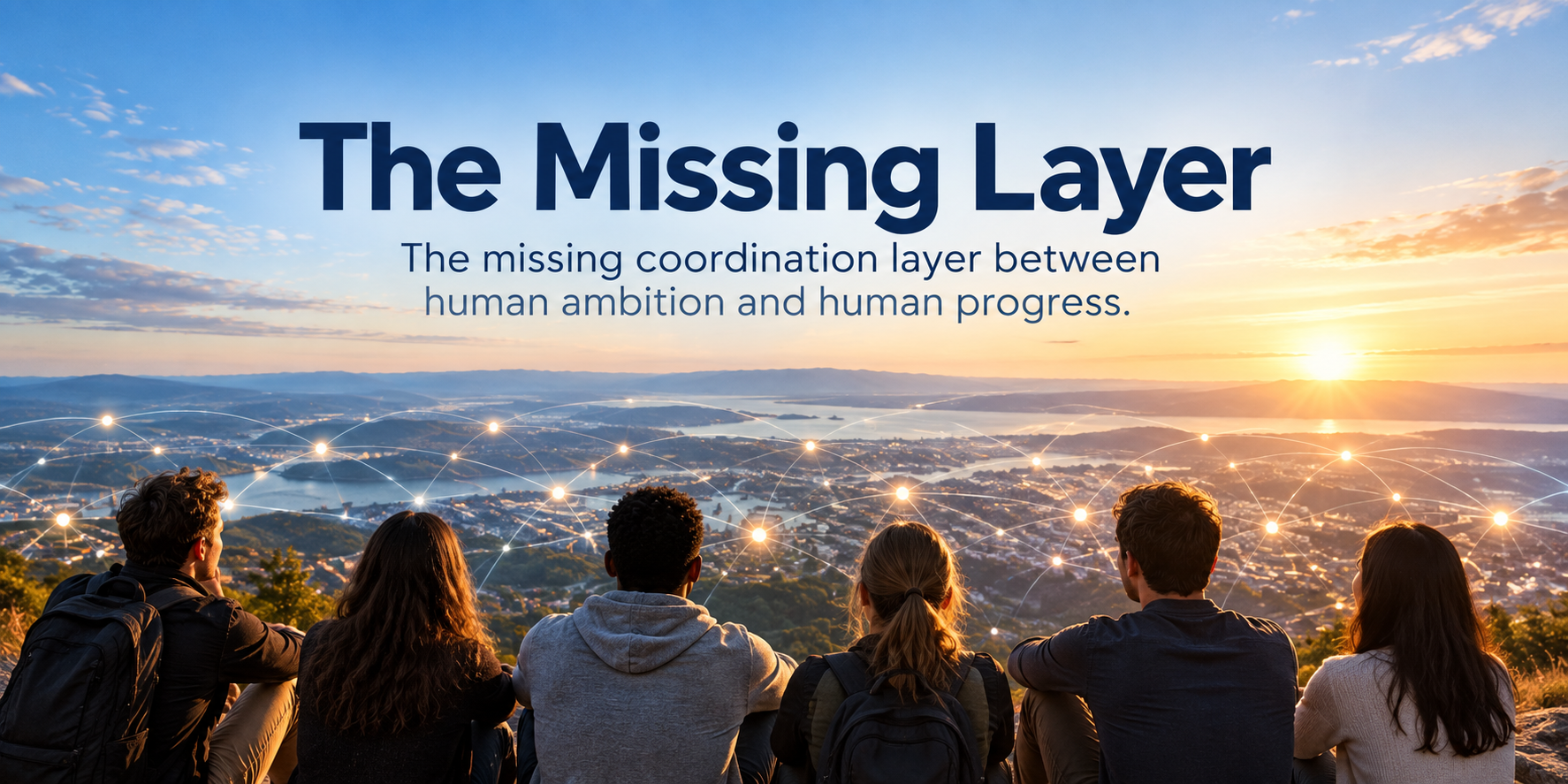
The missing coordination layer between human ambition and human progress.
The Missing Layer isn’t another communication platform. It’s the missing coordination layer between human ambition and human progress.
We live in a world of extraordinary human capability. Billions of people possess knowledge, experience, expertise, creativity, relationships, resources and technology. We can communicate across continents in seconds, publish ideas to a global audience and find information that previous generations could scarcely imagine accessing.
Yet there remains a stubborn gap between recognising that something could be better and organising the people and activities needed to improve it.
That gap is where Ideas-Shared begins.
The World Is Not Short of Ambition
Every day, people identify conditions they want to change, improve, stop, protect, create or achieve.
Some want to improve their own lives or help their families. Others want to develop ideas, build businesses, strengthen organisations, support charities or improve local communities.
Some want to influence public policy, protect the environment, advance scientific research, improve education, tackle crime, question economic decisions or challenge practices they believe are causing harm.
The subject itself is not the point.
The point is that people care, people think, and people want to make a difference.
But recognising an ambition and realising it are two very different things.
An individual may have a compelling idea but lack the knowledge to develop it. A community may recognise a shared problem but struggle to organise a response. A business may identify an opportunity but need capabilities beyond its own organisation. A campaign may attract attention without establishing what participants can practically do next.
In each case, the ambition exists. The potential to make progress exists. What may be missing is an effective way to bring the necessary participation together.
We Have Communication. What About Coordination?
We already have platforms for publishing, messaging, networking, fundraising, campaigning and managing projects. Each serves a useful purpose.
We can share an idea, start a discussion, attract followers, build an audience and express support.
But what happens next?
Who has the knowledge we need? Who is willing to help? What resources are available? What activities need undertaking? Who is doing what? How do we sustain momentum? How will we know whether anything has improved?
Too often, individuals and organisations must piece together their own answers using disconnected tools, relationships and processes.
An ambition may attract attention without attracting the right help. A discussion may produce insight without producing a plan. A group may form without a practical way to organise its work. Valuable activity may take place without its outcomes becoming visible to others.
This is not necessarily a failure of the people involved or of the platforms they use. It reflects the difference between communicating about an ambition and coordinating participation to pursue it.
That is the gap Ideas-Shared is designed to address.
Participation Is How Human Capability Becomes Collective Capability
Meaningful improvements rarely depend on one person possessing every answer, relationship, resource or skill.
Throughout history, people have combined their capabilities to pursue things that mattered to them. Communities have organised around local needs. Businesses have brought people together to develop new products and services. Charities have mobilised volunteers and supporters. Scientific communities have shared knowledge and advanced research.
The circumstances differ, but a common possibility emerges:
Participation can create leverage. Leverage can bring capabilities together. Combined capabilities can make improvements possible that individuals could not achieve alone.
None of this guarantees success. Ambitions may prove difficult, attract little support or require approaches that change over time.
But people have more options when they can find one another, understand what is needed and organise their contributions intelligently.
That is why Ideas-Shared places voluntary participation at the centre of its operating model.
A Common Way to Move from Ambition to Action
Ideas-Shared is not intended to replace governments, businesses, charities, communities, existing networks or democratic institutions.
Nor is its purpose to decide which ambitions people should pursue or require participants to agree with one another.
Its purpose is to provide participation infrastructure: a common environment, philosophy, methodology and set of practical tools through which individuals, informal groups and organisations can pursue the ambitions that matter to them.
At its heart is Intelligent Collaboration — an approach that enables people with the same and different perspectives, interests and capabilities to challenge assumptions, make others aware, stop what needs stopping and co-create new realities through a common operating model.
The Ideas-Shared Global Hub gives ambitions somewhere to begin and become visible. Activity Listings help people explain what they want to do and how others can participate. The Ambition Operating System provides a seven-step route from registering an ambition through to organising activity, delivering outcomes and moving forward.
Some ambitions may need only a conversation, an introduction or an answer. Others may require a team, a plan, resources and sustained effort.
The aim is not to make every ambition complicated. It is to make organised participation more accessible when it is needed.
From Individual Ambitions to a Wider Ambition Economy
Imagine what becomes possible when people no longer have to approach every ambition as an isolated coordination problem.
A person with an idea can make it visible. Somebody with relevant experience can discover it. A potential partner can express interest. Supporters can share it. Participants can organise the work. Others can learn from the activity and outcomes.
Now extend that possibility across personal, professional and societal ambitions.
Some activities will involve two people. Others may involve small teams, communities, organisations or wider networks. A few may attract participation on a much larger scale.
Ideas-Shared does not determine which ambitions gain support. The people who choose to participate determine where their time, knowledge, resources and effort go.
As more ambitions, participants and activities become connected, the opportunity is for an Ambition Economy to develop: one in which people can discover what matters to others, contribute what they can and organise around the outcomes they want to pursue.
The value lies not simply in the number of people connected, but in what those connections enable people to do.
The Missing Layer
Humanity has no shortage of ideas, concerns, aspirations or capable people.
We have many ways to communicate. We have organisations and institutions that perform essential roles. We have technologies that make connection easier than ever before.
What is less readily available is a common, accessible way to move from:
“This matters to me.”
to:
“Who else cares, what can each of us contribute, and what can we do about it together?”
That is the missing coordination layer between human ambition and human progress.
Ideas-Shared has been developed to help provide it — not by prescribing what people should want, but by helping them organise voluntary participation around what they decide matters.
One person can begin. Others can discover, connect, contribute, support and act. Together, they can pursue changes that might otherwise remain ideas, frustrations or unrealised opportunities.
That is the missing layer.
That is why Ideas-Shared exists.