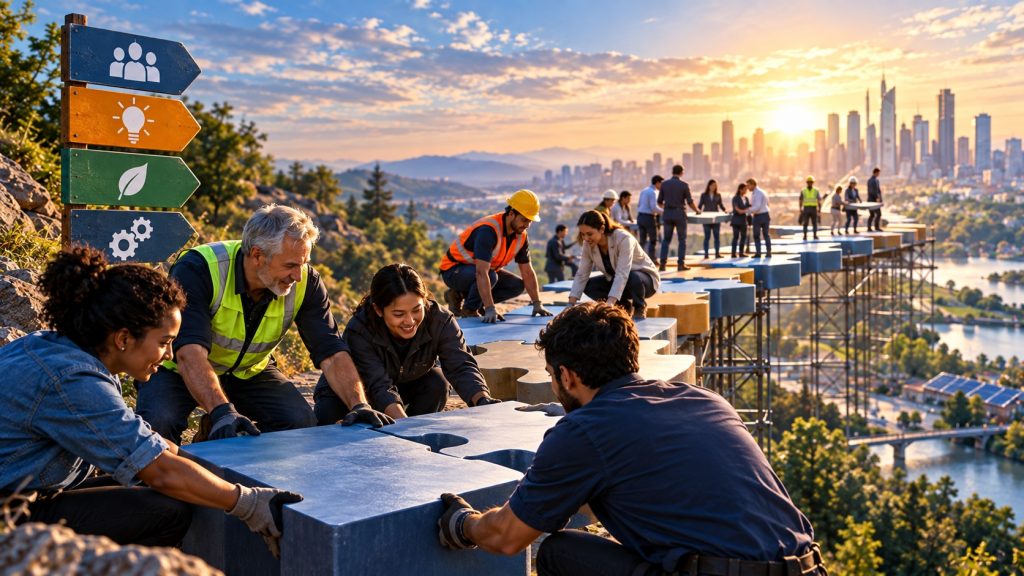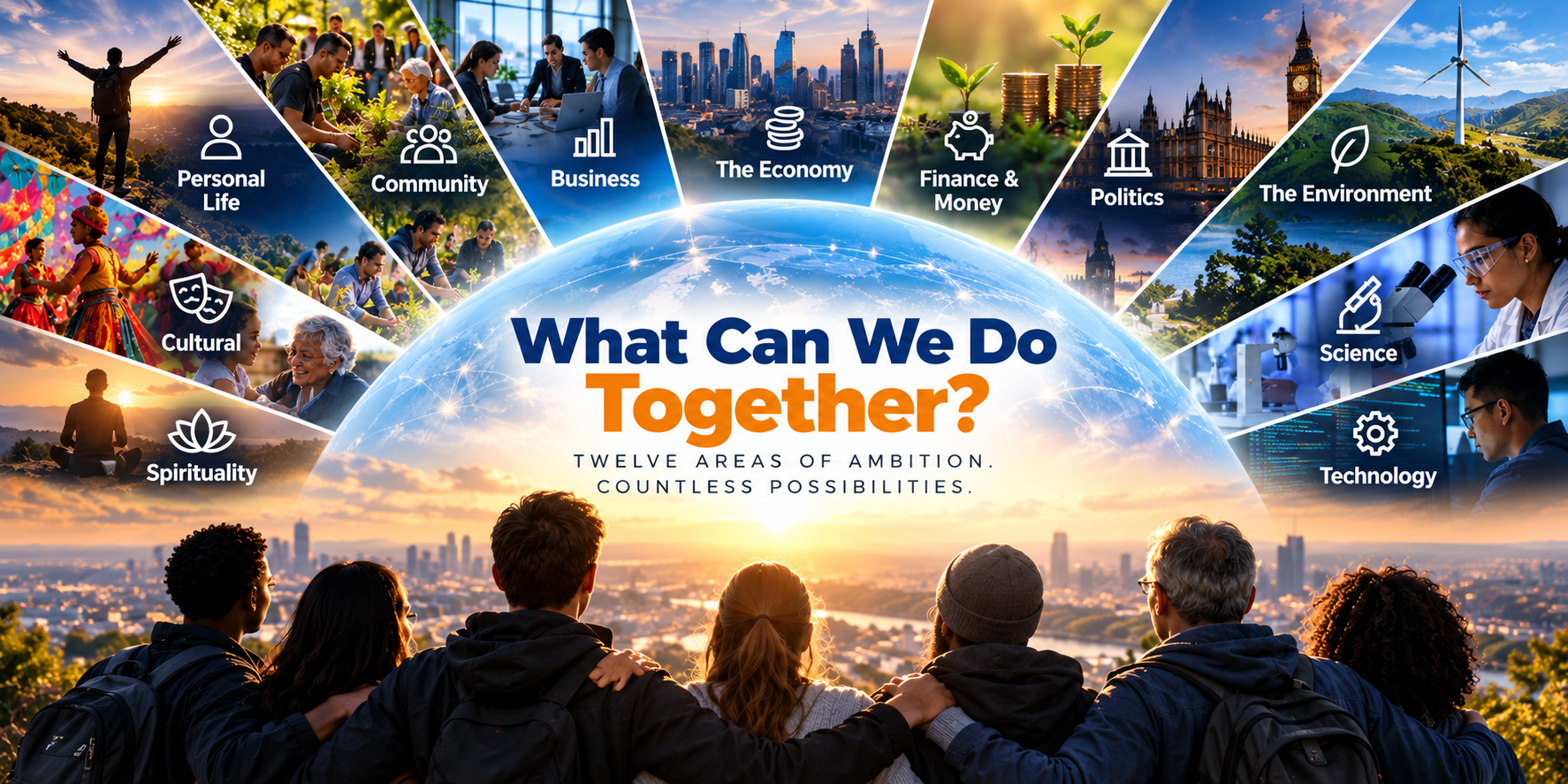
Twelve areas of ambition. Countless possibilities. One way to find each other and act.
What would you like to change, improve, stop, protect, create or achieve?
Perhaps you have an ambition for your own life. Perhaps you see an opportunity at work, a problem in your community, or something happening in the wider world that you believe deserves attention.
You may already know what you want to do but lack the time, knowledge, resources or connections to make it happen. Or perhaps you know you want things to be different but haven’t yet decided where to begin.
Now consider a different question:
What could become possible if you connected with others who share your interest, understand the challenge or have something useful to contribute?
That question is at the heart of Ideas-Shared.
We believe people should have the opportunity to decide what matters to them, initiate activities without waiting for permission, and combine their capabilities voluntarily to pursue meaningful outcomes.
And the possibilities extend across almost every area of life.
1. Personal Life — What Could We Achieve for Ourselves and Each Other?
Personal ambitions are sometimes the most important ambitions of all.
We may want to improve our health, learn something new, find work, develop a talent, overcome a difficulty, become more independent or pursue a dream we have put aside for years.
What could we do together?
- Help someone acquire a new skill or qualification.
- Share experience with people facing similar life challenges.
- Find mentors, collaborators or practical support.
- Create opportunities for friendship, recreation and personal development.
- Help someone turn a long-held idea into something real.
- Share knowledge that saves others time, money or unnecessary difficulty.
An ambition does not become less significant because it concerns one person.
Sometimes helping one person make progress changes the possibilities available to an entire family.
2. Community — What Could We Improve Where We Live?
Every community has people who care about what happens around them.
They notice neglected places, unmet needs, opportunities for improvement and things that could bring people closer together.
Yet those people may never meet, even when they share the same ambitions.
What could we do together?
- Improve parks, playgrounds, streets and shared spaces.
- Organise local events, activities and community projects.
- Support neighbours who need practical assistance.
- Bring residents and local organisations together around shared priorities.
- Create opportunities for young people and older generations.
- Develop solutions to local transport, access or safety problems.
- Share equipment, facilities, knowledge and resources.
A community does not need to wait for every improvement to arrive from somewhere else.
People can identify what matters, find others who care and organise what they are able to do.
3. Cultural — What Could We Preserve, Share and Create?
Culture shapes how people understand themselves, connect with others and experience the world.
It includes our languages, traditions, heritage, arts, music, stories, food, celebrations and creative expression.
What could we do together?
- Preserve local history and cultural heritage.
- Share traditions, stories and experiences across generations.
- Organise exhibitions, performances, festivals and creative events.
- Help artists, musicians, writers and other creators find audiences and collaborators.
- Make cultural activities more accessible.
- Explore different perspectives through respectful exchange.
- Develop new creative projects that bring people together.
Culture is not only something we inherit or consume.
It is also something we can contribute to, protect and create.
4. Social Conditions — What Could We Do to Improve Everyday Life?
Many people experience difficulties that are not easily resolved by individual effort alone.
Isolation, inadequate support, inaccessible services, poor living conditions and barriers to opportunity can affect people throughout their lives.
What could we do together?
- Identify gaps in services and practical support.
- Develop activities that reduce loneliness and isolation.
- Connect people with relevant knowledge, assistance and opportunities.
- Improve accessibility and inclusion in everyday settings.
- Share experiences that help others understand unmet needs.
- Develop practical responses to problems affecting families and communities.
- Bring people and organisations together to improve how support is delivered.
People experiencing a problem often understand important aspects of it that others may overlook.
Their knowledge can become part of developing a better response.
5. Business — What Could We Build and Improve Together?
Businesses are full of ambitions, ideas, problems and opportunities.
A founder may need expertise. A small business may need customers or collaborators. An established organisation may see opportunities to improve performance but struggle to connect the right people and capabilities.
What could we do together?
- Develop and test new business ideas.
- Find partners, customers, suppliers and specialist expertise.
- Improve products, services and customer experiences.
- Identify waste, reduce costs and improve productivity.
- Share knowledge and develop new capabilities.
- Create opportunities for smaller businesses to participate in larger projects.
- Bring organisations together to address common industry challenges.
Not every business opportunity needs to begin with a formal partnership or major investment.
Sometimes progress begins with one useful introduction.
6. Finance & Money — What Could We Do to Improve Financial Opportunities?
Money affects the choices available to individuals, families, businesses and communities.
People may want to reduce costs, improve their financial knowledge, generate income, find funding or develop more resilient financial arrangements.
What could we do together?
- Share practical knowledge about managing money.
- Identify opportunities to reduce household or business costs.
- Develop new income-generating ideas.
- Connect entrepreneurs and projects with potential funding sources.
- Share experiences of financial products and services.
- Explore ways to improve financial access and understanding.
- Develop practical responses to common financial difficulties.
Knowledge that helps one person make a better financial decision may also help many others.
7. The Economy — What Could We Do to Create Wider Opportunity?
The economy is not an abstract system separate from everyday life.
It is shaped by the work people do, the businesses they create, the services they provide, the skills they develop and the opportunities available to them.
What could we do together?
- Develop employment and enterprise opportunities.
- Connect skills with emerging needs.
- Improve productivity and reduce avoidable waste.
- Support local economic activity.
- Explore new markets and business models.
- Develop ideas for better infrastructure and services.
- Bring together people with different economic experiences to examine problems and opportunities.
Economic ambitions may begin locally or extend across industries and countries.
The common thread is finding ways for people to contribute their capabilities and pursue opportunities.
8. Politics — What Could We Examine and Address Together?
Political decisions affect public services, taxation, infrastructure, rights, responsibilities and many other aspects of life.
People hold different views about what should change, what should remain and how competing priorities should be addressed.
Ideas-Shared provides opportunities for people to explore issues and participate voluntarily, without requiring everyone to share the same political outlook.
What could we do together?
- Ask questions about public decisions and their consequences.
- Examine policy proposals and available evidence.
- Share experiences of how decisions affect different people.
- Develop and discuss alternative approaches.
- Improve public understanding of complex issues.
- Bring relevant knowledge and perspectives into civic discussions.
- Organise lawful participation around issues people independently choose to pursue.
Constructive participation does not require universal agreement.
It requires opportunities to examine issues, understand differences and determine what action, if any, people wish to take.
9. The Environment — What Could We Protect and Restore Together?
Environmental ambitions can begin with a single street, river, woodland or coastline.
They can also involve larger challenges that cross community and national boundaries.
What could we do together?
- Clean and restore local places.
- Reduce waste and improve resource use.
- Protect habitats and biodiversity.
- Share practical environmental knowledge.
- Develop ideas for more sustainable products and services.
- Organise community conservation activities.
- Connect people and organisations working on related environmental challenges.
An individual action may appear small, but shared activities can combine knowledge, resources and effort across a much wider area.
10. Science — What Could We Discover and Understand Together?
Scientific progress depends on curiosity, questions, evidence, investigation and the exchange of knowledge.
Important questions can originate with researchers, professionals, communities or individuals who notice something worth understanding.
What could we do together?
- Share research questions and observations.
- Connect people with relevant scientific expertise.
- Support citizen-science activities.
- Improve access to scientific knowledge.
- Explore practical applications of research.
- Bring different disciplines together around complex problems.
- Identify needs that could benefit from further investigation.
Not everyone needs to be a scientist to contribute a useful question, observation or practical insight.
11. Spirituality — What Could We Explore and Share?
People seek meaning, purpose, belonging and understanding in different ways.
For some, spirituality is connected with religious belief. For others, it concerns reflection, personal values, connection with nature or questions about life and existence.
What could we do together?
- Create opportunities for reflection and personal exploration.
- Share experiences and perspectives respectfully.
- Support people seeking connection and belonging.
- Develop community activities rooted in compassion and mutual support.
- Explore questions of meaning, purpose and personal values.
- Encourage understanding across different beliefs and traditions.
- Connect people who wish to pursue shared spiritual or reflective activities.
Participation should remain a matter of personal choice, with room for different beliefs and perspectives.
12. Technology — What Could We Make Possible?
Technology can help people solve problems, connect capabilities and create opportunities that were previously difficult or impossible to pursue.
But useful technology begins with understanding what people actually need.
What could we do together?
- Develop tools that solve practical problems.
- Share technical knowledge and skills.
- Improve digital accessibility.
- Help people and organisations use existing technology more effectively.
- Connect developers with people who understand real-world challenges.
- Explore new applications for emerging technologies.
- Reduce duplication by sharing ideas, solutions and experience.
The opportunity is not simply to create more technology.
It is to use technology to expand what people can do.
Twelve Areas. But Real Ambitions Rarely Fit Neatly into One.
Consider an ambition to improve employment opportunities in a community.
It might involve personal development, business, finance, the economy, social conditions, technology and local decision-making.
An ambition to improve a neglected public space might connect community, environmental, cultural and social interests.
A new idea for supporting older people might require knowledge from science, technology, business, finance and personal experience.
The areas help people discover what interests them. They are not boundaries around what people can achieve.
That is one reason Ideas-Shared is designed as a shared participation network rather than twelve separate systems.
People can bring different interests, experiences and capabilities to the same ambition.
You Don’t Have to Start Everything Yourself
Perhaps the most important opportunity is also the simplest.
You may already have something valuable to contribute to an activity someone else has begun.
You might answer a question, share knowledge, offer help, suggest an improvement, make an introduction, attend an event, develop an idea or take responsibility for a task.
Equally, you may have an ambition that needs other people.
You can create a listing, explain what you want to achieve and invite participation.
Some activities may need little more than an exchange of information. Others may develop into teams, plans and coordinated delivery.
Start with the activity. Bring in others where useful. Organise what needs doing. Work towards an outcome.
The process should serve the ambition, not become an obstacle to pursuing it.
What Happens When More People Participate?
Imagine these opportunities becoming easier to discover and pursue across communities, organisations, industries and countries.
People could spend less time searching for relevant knowledge and connections. Existing activities could reach more potential contributors. Ideas and solutions could travel beyond the places where they originated.
Individuals could find opportunities that would otherwise remain invisible to them. Organisations could identify shared interests and capabilities beyond their usual boundaries.
And people who have never thought of themselves as organisers, innovators or changemakers could discover that they have something useful to contribute.
Not every ambition will succeed. Not every activity needs to become a major undertaking.
But every additional opportunity to connect people around something meaningful expands what they may be able to pursue.
Personal sovereignty becomes collective capability.
So, What Can We Do Together?
We can improve one thing in our own lives.
We can help someone else achieve something important.
We can address a problem in our community, develop a business opportunity, share knowledge, protect something valuable, explore an unanswered question or create something that does not yet exist.
We can begin small. We can work at scale. We can contribute to activities already underway or initiate something entirely new.
And we do not all need to pursue the same ambitions.
Ideas-Shared exists to make it easier for individuals, informal groups and organisations to find one another, organise voluntary participation and work towards outcomes that matter to them.
Twelve areas of ambition. Countless possibilities. One shared participation network.
The question is no longer only what you can do on your own.
What can we do together?