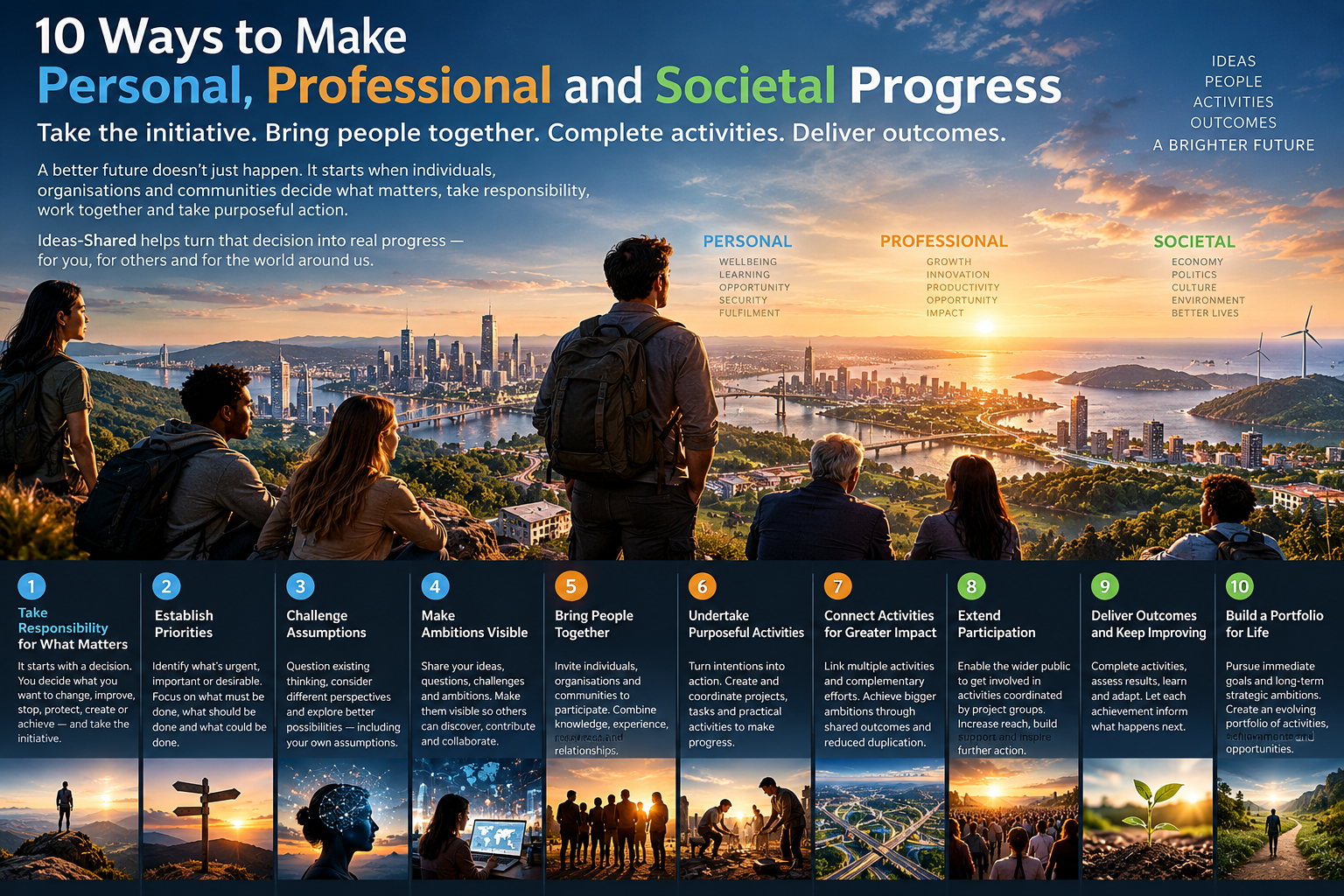
Take the initiative. Bring people together. Complete activities. Deliver outcomes.
What if more of us decided to take responsibility for changing, improving or creating the things that matter to us?
Not waiting for someone else to identify the problem, establish the priority, propose a solution or make the first move.
Not simply expressing opinions, sharing frustrations or hoping circumstances will improve.
But making a conscious decision to do something.
That decision might concern our personal lives, families, careers, businesses or communities. It might involve the economy, politics, culture, public services, environmental protection or conditions affecting society.
Some ambitions are immediate. Others may take years or generations.
Some are urgent. Others are important but not urgent. Some concern what must change, while others represent opportunities to explore what could become possible.
Whatever the ambition, progress begins when someone decides that something matters enough to act upon.
That’s the principle behind Ideas-Shared.
A self-serve participation network where individuals, informal groups and organisations can take the initiative, invite others to participate, undertake purposeful activities and pursue outcomes that matter to them.
You decide what matters. You decide whether to act. You decide whether to involve others.
And everyone else has the same opportunity.
Here are ten ways to make it happen.
1. Take Responsibility for What Matters
Before anything changes, someone has to decide that something deserves attention.
It might be a personal challenge, an opportunity at work, a problem affecting a community or a situation influencing millions of lives.
The first step isn’t necessarily physical action.
It’s the mental decision to take responsibility for what happens next.
That doesn’t mean accepting responsibility for every problem or believing we can solve everything ourselves.
It means recognising our ability to question circumstances, consider alternatives, initiate activity and invite others to help.
Ideas-Shared is self-serve by design.
You don’t need someone else to decide which ambitions matter to you or organise your participation.
You can take the initiative yourself.
And so can every other individual, informal group or organisation.
Personal responsibility is the starting point. Collective capability is what becomes possible when people choose to participate together.
2. Decide What Must, Should and Could Be Done
We all have competing priorities.
Some things demand immediate attention. Others are important but can be addressed over time. Some represent opportunities rather than necessities.
The challenge is deciding where our attention, effort and resources can make the greatest difference.
What must change?
What should improve?
What could we create or achieve?
What’s urgent? What’s important? What can wait?
And what deserves sustained effort over years?
These questions apply equally to personal finances, business strategy, economic conditions, political accountability, environmental challenges and community development.
An ambition might be urgent and important, long-term and strategically significant, or simply an opportunity worth exploring.
There is no single formula for every situation.
The responsibility is to establish priorities that make sense, understand their implications and revisit them as circumstances change.
Because progress isn’t just about doing more.
It’s about doing more of what matters.
3. Challenge Assumptions — Starting With Our Own
Taking responsibility also means being willing to question what we think we know.
Are we addressing the real problem?
Have we understood the circumstances?
Are our priorities appropriate?
Are existing practices still relevant?
Could there be a better approach?
And are we prepared to reconsider our own assumptions?
Sometimes we know the outcome we want but haven’t identified the best way to achieve it.
Sometimes the problem is different from the one we initially imagined.
And sometimes new knowledge, perspectives or relationships reveal possibilities we hadn’t considered.
Ideas-Shared encourages people to challenge assumptions, make others aware, stop what needs stopping and co-create new realities.
The objective isn’t to defend our original thinking. It’s to improve our understanding and make better decisions about what happens next.
That is as important for an individual making a personal decision as it is for a business, institution, community or government considering its future.
4. Make Your Ambitions Visible
An ambition that remains private may never attract the people capable of helping.
Once you’ve decided that something matters, you can make it visible.
Through Ideas-Shared, members can create activity listings to share ambitions, ideas, questions, problems, solutions, opportunities and requests for help.
Some may require only a conversation, an introduction or specialist advice.
Others may develop into substantial projects requiring multiple activities, resources and participants.
You might want to improve your financial circumstances, explore a business opportunity, address a community problem, challenge an established practice or contribute to a wider societal ambition.
Whatever the starting point, making it visible creates opportunities for others to discover it.
Someone you haven’t met may have the knowledge, experience, relationships or capabilities that could make all the difference.
And equally, you may discover ambitions initiated by others where your contribution could prove invaluable.
Self-serve participation works in both directions.
You can initiate your own ambitions and choose to help others realise theirs.
5. Galvanise People to Participate
Deciding to act doesn’t mean having to act alone.
People have always combined their knowledge, experience, relationships, capabilities and resources to achieve things.
Ideas-Shared expands the opportunities to discover one another and collaborate around ambitions that matter.
An individual might need professional expertise.
A business might benefit from a university, charity or community organisation.
A public body might work alongside residents, specialists and local businesses.
A societal ambition might involve people and organisations across industries, communities and countries.
Some participants may offer advice. Others may contribute practical support, specialist skills, relationships, funding or resources.
Some may become part of a project team. Others may help with a particular activity and then move on.
Anyone can ask for help. Anyone can offer help. And any combination of individuals, informal groups and organisations can come together to get things done.
The decision to participate remains voluntary.
And that matters.
Because genuine collaboration begins when people choose to contribute, not simply because someone tells them to.
6. Turn Decisions Into Purposeful Activities
This is where intention becomes action.
Recognising a problem is important.
Understanding it is important.
Discussing alternatives and agreeing what should happen can be important.
But none of these necessarily delivers the desired outcome.
Something has to be done.
People may need to investigate, plan, organise, negotiate, communicate, design, build, coordinate, implement or undertake other practical activities.
Ideas-Shared supports members in forming project groups, planning tasks, assigning responsibilities and progressing activities towards delivery.
Some activities may be completed quickly.
Others may require sustained effort, different capabilities and several stages of work.
The objective isn’t simply to attract attention to an ambition. It’s to complete the activities necessary to make meaningful progress.
And those activities should be purposeful.
They should contribute towards something that matters, whether that’s helping one person, improving an organisation or addressing a challenge affecting society.
Taking responsibility means following through on the decision to act.
7. Connect Activities to Achieve Bigger Ambitions
One ambition doesn’t necessarily mean one activity.
Consider an ambition to improve employment opportunities in a community.
It might involve understanding local needs, engaging employers, developing skills, improving transport, supporting entrepreneurship, attracting investment and creating new opportunities.
Each requirement could become a separate activity listing.
Different people and organisations might contribute to each.
Some activities could run simultaneously. Others might depend on earlier work being completed.
Together, their outcomes could contribute towards the larger ambition.
One ambition. Multiple listings. Different teams. Connected outcomes.
The same principle applies to personal financial independence, business transformation, economic development, cultural initiatives, political reform and environmental protection.
And activities don’t necessarily contribute to only one ambition.
Improving transport, for example, might also support employment, education, economic productivity, environmental objectives and community wellbeing.
By recognising these connections, participants can coordinate efforts, reduce duplication, combine capabilities and build upon work already undertaken.
Individual activities can become building blocks for much larger achievements.
This also creates opportunities for strategic imperatives — enduring priorities supported by successive ambitions and activities over many years.
Short-term achievements can contribute towards long-term goals.
And long-term ambitions can provide direction for the activities we undertake today.
8. Extend Participation Beyond Membership
Taking responsibility for an ambition doesn’t mean limiting participation to those directly involved in coordinating it.
Ideas-Shared members can initiate ambitions, form project groups and organise purposeful activities.
But where wider involvement is appropriate, those activities can extend beyond the membership itself.
The general public can become aware of initiatives and choose to support or participate in specific actions encouraged and coordinated by project groups.
This is particularly relevant when ambitions concern communities, economic conditions, public services, cultural interests, environmental protection or other societal matters affecting large populations.
A relatively small project group might coordinate an initiative involving thousands or even millions of people.
The size of the coordinating team doesn’t have to determine the scale of participation or potential impact.
And as more people discover the ambitions being pursued, the activities taking place and the outcomes being achieved, some may decide to become Ideas-Shared members themselves.
They may want to initiate their own ambitions, participate more directly or help others achieve theirs.
Participation can begin in different ways.
What matters is that people recognise the opportunity and make their own decision to become involved.
9. Deliver Outcomes, Learn and Keep Improving
Taking responsibility doesn’t end when an activity begins.
It means remaining interested in what happens as a result.
Was the activity completed?
Did it achieve its intended purpose?
What changed?
What improved?
What was learned?
And what needs to happen next?
Completing a task isn’t necessarily the same as achieving an ambition.
An activity might reveal new information, expose an incorrect assumption or demonstrate that a different approach is required.
Priorities may need to change.
Additional activities may become necessary.
Different people or resources may be needed.
The objective isn’t simply to stay busy. It’s to deliver outcomes that matter.
And when an ambition is realised, participation doesn’t have to end.
People can take their knowledge, experience, relationships and capabilities into new activities.
Teams can disperse, reform or collaborate in different combinations.
Each outcome may create opportunities that weren’t visible at the beginning.
Decide. Act. Deliver. Learn. Improve. Repeat.
10. Build a Portfolio of Ambitions for Life
Now imagine applying this approach throughout your life.
At any given moment, you might have several ambitions.
Some personal. Some professional. Some societal.
Some immediate. Some long-term.
Some urgent. Some important.
Some concerning what must change, others involving what could be improved or created.
You might initiate some ambitions yourself and choose to contribute to others.
Over time, these can form an evolving portfolio of ambitions, activities, participation and achievements.
For an individual, that might involve financial security, education, career development, family wellbeing, lifelong learning or contributing to society.
For a business, it might involve growth, competitiveness, innovation, productivity, sustainability and long-term transformation.
For communities and society, it might involve economic prosperity, political accountability, cultural development, environmental protection, public services and opportunities for future generations.
Some ambitions may be realised quickly.
Others may require successive activities, different participants and sustained effort over many years.
And some may become strategic imperatives that guide decisions and activities for decades.
One activity may contribute to several ambitions. Several ambitions may support a strategic imperative. And one strategic imperative may guide purposeful activity across generations.
Your portfolio doesn’t have to represent a fixed plan.
It can evolve as your circumstances, understanding, priorities and opportunities change.
Someone might join Ideas-Shared as a teenager and continue participating throughout their working life, retirement and beyond.
Their ambitions may change completely.
But the opportunity to decide what matters, take the initiative, collaborate and achieve meaningful outcomes remains.
Not one ambition. Not one project. Not one stage of life.
A lifetime of opportunities to make a difference.
Imagine What We Could Achieve Together
Imagine millions of individuals, informal groups and organisations making a conscious decision to take greater responsibility for the things that matter to them.
Not waiting for someone else to decide what deserves attention.
Not assuming that existing circumstances are inevitable.
Not believing that meaningful change must always begin somewhere else.
But questioning, prioritising, initiating and participating.
Imagine ambitions becoming visible across personal, professional and societal life.
People discovering one another, challenging assumptions and combining their capabilities.
Activity listings becoming the starting point for purposeful collaboration.
Different teams undertaking practical work.
Multiple activities contributing towards larger ambitions.
Short-term achievements supporting long-term strategic imperatives.
And individuals and organisations building evolving portfolios of ambitions, activities and outcomes throughout life.
Some achievements might change one person’s circumstances.
Others could transform businesses, strengthen communities, improve public services, create economic opportunities, protect the environment or contribute to wider societal progress.
Not every ambition will succeed. Not every activity will deliver its intended outcome.
But the opportunity to participate, learn, adapt and try again remains.
And as more people take the initiative, more opportunities emerge to connect knowledge, experience, relationships, capabilities and resources around the things that matter.
The world doesn’t lack ambitions worth pursuing, people capable of contributing or activities worth undertaking.
The opportunity is to bring them together, establish priorities and turn collective capability into real outcomes.
And it begins with something remarkably simple.
A decision.
The decision to take responsibility for what matters.
The decision to initiate rather than simply observe.
The decision to participate rather than wait.
And the decision to work with others when together we can achieve more.
That’s the purpose of Ideas-Shared.
To enable people to take the initiative, galvanise participation, complete purposeful activities and deliver personal, professional and societal progress — today, tomorrow and throughout life.
Ideas-Shared
Changing the way people come together to get things done.