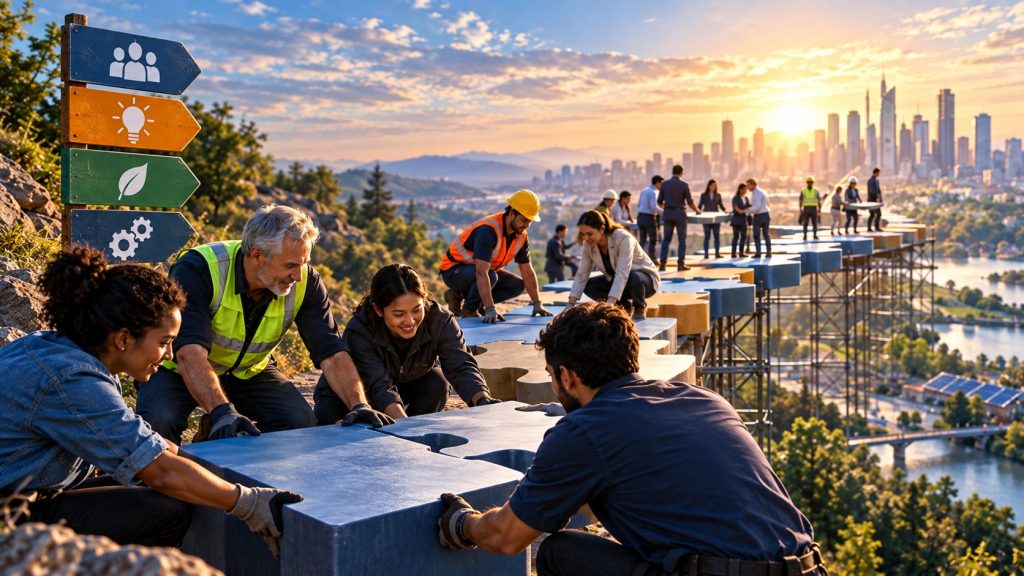
What happens when we stop imagining only what we could achieve individually and start exploring what might become possible collectively?
Think about something you would like to change, improve, solve, create, protect, stop or achieve.
It could be something personal.
Something affecting your family, career, business or community.
Or something much bigger — a challenge facing your country, an industry or the wider world.
Now ask yourself a simple question.
What could I do about it?
Chances are, your answer will be influenced by what you already know.
Your experience. Your skills. Your relationships. Your resources. Your circumstances.
And, perhaps most importantly, what you believe is possible.
You might identify something you could do immediately.
You might decide you need help.
Or you might conclude that what you want to achieve is simply beyond your reach.
But what if you’re asking the wrong question?
The Limits of Individual Thinking
When we consider what we can achieve individually, we naturally see the world through the lens of our own capabilities and experiences.
We know what we know.
We have access to the people and resources we already know about.
We recognise opportunities based on what we’ve previously encountered.
And we make judgements about what’s possible using the information available to us.
There’s nothing inherently wrong with that.
But it creates a limitation.
Our perception of what’s possible is often constrained by the boundaries of our own thinking.
We may dismiss an idea because we don’t know how to make it happen.
Abandon an ambition because we lack the resources.
Accept a problem because we cannot see a solution.
Or overlook an opportunity because we’ve never considered another way of doing things.
And sometimes, we don’t even imagine something better because our existing circumstances have conditioned us to accept what already exists.
But those limitations aren’t necessarily limitations of the ambition itself.
They’re limitations of what we currently know, who we know and what we believe we can achieve.
Now Change the Question.
Instead of asking:
What could I achieve?
Ask:
What could we achieve together?
Suddenly, the perspective changes.
The knowledge you don’t possess might be available to somebody else.
The experience you lack might be commonplace in another organisation.
The resources you need might already exist somewhere.
The problem you cannot solve might have been overcome by somebody you’ve never met.
And the opportunity you haven’t recognised might be obvious to someone with an entirely different perspective.
Now extend that thinking beyond the people you already know.
Imagine being able to discover and work with individuals, informal groups, businesses, charities, public bodies, governments, universities, researchers and organisations of every description.
Across communities, industries, countries and continents.
People and organisations with different experiences, perspectives, capabilities, relationships, resources and ambitions.
Your individual limitations no longer have to define the boundaries of your collective possibilities.
And that’s only the beginning.
What If Other People Could Help Us Imagine Something Better?
There’s an important difference between asking others to help us achieve something we’ve already decided upon and inviting them to explore what might be possible.
In the first situation, the ambition is largely predetermined.
We know what we want.
We simply need additional knowledge, resources or assistance to make it happen.
But in the second situation, the ambition itself can evolve.
Someone questions an assumption.
Another person offers a different perspective.
An organisation identifies an opportunity nobody had considered.
A specialist challenges the proposed approach.
A new connection reveals capabilities that were previously unknown.
And suddenly, what began as one person’s idea becomes something entirely different.
Perhaps something better.
Perhaps something much bigger.
Perhaps something nobody involved could have imagined independently.
Collective participation doesn’t just expand what we can achieve. It can expand what we’re capable of imagining.
And that changes everything.
Imagine Applying This Thinking to the World.
Consider the billions of people who inhabit our planet.
Now consider the countless informal groups and millions of organisations operating across every aspect of human life.
Each with its own experiences, knowledge, challenges, opportunities, ambitions and capabilities.
What if more of them could discover one another?
What if they could challenge assumptions together?
What if they could identify problems, share solutions, explore opportunities and combine their resources?
What if they could work together without needing to belong to the same organisation, profession, community or country?
And what if they could do so as often as they wanted, on whatever mattered to them?
Think about the possibilities.
A young person could develop an idea with the support of experienced professionals.
A community could discover how another community overcame a similar challenge.
Businesses could collaborate to create opportunities that none could pursue independently.
Charities, researchers, public bodies and volunteers could combine their capabilities around persistent societal problems.
Individuals could challenge established thinking, attract support and initiate meaningful change.
And entirely new ambitions could emerge from conversations between people and organisations that might otherwise never have encountered one another.
Some outcomes might benefit one person.
Others could benefit families, businesses, communities or entire countries.
Some might be achievable tomorrow.
Others could take generations.
And some of the greatest achievements might begin with possibilities nobody has imagined yet.
From Individual Ambition to Collective Capability
Of course, imagining something doesn’t make it happen.
Ideas need to be explored.
Assumptions need to be challenged.
Opportunities need to be evaluated.
People need to find one another.
Resources need to be identified.
Activities need to be organised.
And practical action needs to follow.
That’s where the difference between imagining possibilities and achieving outcomes becomes important.
Because the world doesn’t suffer from a shortage of ideas, frustrations, challenges, opportunities or ambitions.
It suffers, in part, from the difficulty of connecting these things with the people and capabilities needed to make progress.
We have extraordinary human potential distributed throughout the world.
But much of it remains disconnected.
What if we could bring more of it together?
That’s Why We Created Ideas-Shared.
Ideas-Shared was created to change the way people come together to get things done.
To give individuals aged 16 and over, informal groups and organisations of every description a common environment in which to identify, share, explore, prioritise, progress and deliver their ambitions.
Across personal, professional and societal life.
With people they know and those they’ve yet to meet.
Not by deciding what people should think.
Not by determining which ambitions matter.
Not by prescribing what the world should achieve.
But by making it possible for participants to decide for themselves.
To challenge assumptions.
To make others aware.
To stop what needs stopping.
And to co-create new realities.
Through everyday activities that anyone eligible can initiate and others can help progress.
An idea can become an activity.
An activity can attract participation.
Participation can reveal new knowledge, perspectives, capabilities and opportunities.
Those discoveries can change the ambition, strengthen the approach or inspire entirely new activities.
And successful outcomes can become foundations for further progress.
Again and again.
One network. Countless combinations. Unlimited possibilities.
The Greatest Possibility May Be the One Nobody Has Considered.
Here’s the really interesting part.
Nobody knows what the greatest achievement made possible through Ideas-Shared might be.
Not its founder.
Not its members.
Not the organisations that participate.
Because it might begin with an ambition that hasn’t yet been expressed.
A conversation that hasn’t yet happened.
A connection between people who haven’t yet met.
Or a question nobody has thought to ask.
And that’s precisely why opening up participation matters.
We don’t have to imagine everything ourselves.
We don’t have to possess every capability.
And we don’t have to know everyone who could help.
We need ways to discover one another, explore possibilities and turn shared ambitions into practical action.
So, What Could We All Achieve Together?
Perhaps it’s time to reconsider how we think about progress.
Instead of beginning with what we lack, we could explore what others might contribute.
Instead of accepting established assumptions, we could challenge them.
Instead of limiting ambitions to what we can accomplish independently, we could consider what might become possible collectively.
And instead of waiting for somebody else to decide what needs doing, we could begin ourselves.
Because the question isn’t simply whether other people could help us achieve what we already want.
It’s what we might discover, imagine and achieve together that none of us could have conceived of alone.
That is a much bigger question.
And one worth asking across every aspect of personal, professional and societal life.
Imagine what we could all achieve together.
Then imagine having a practical way to find out.
Ideas-Shared — Changing the way people come together to get things done.
Your choice. Your participation. Our collective potential.