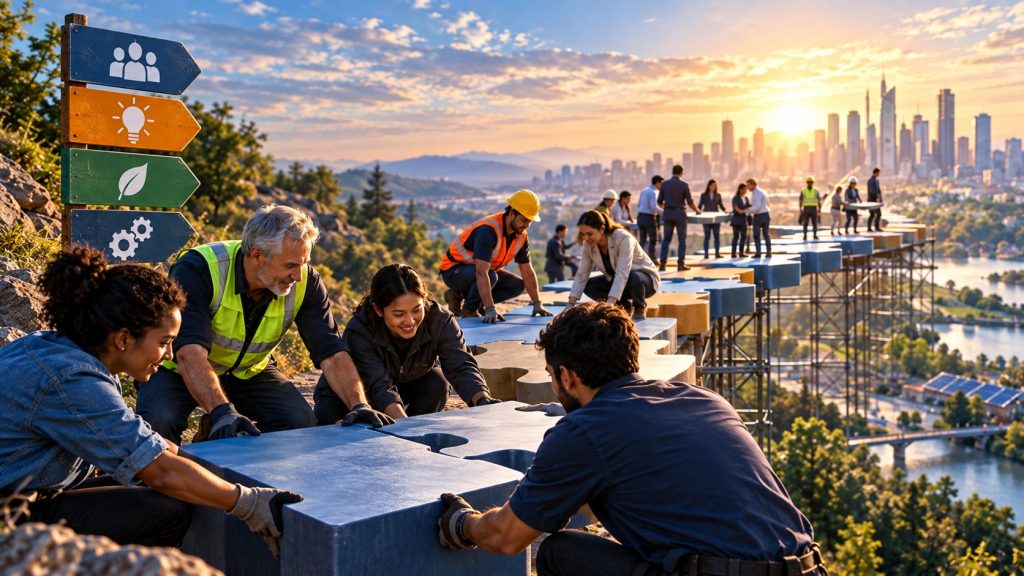
If we want different outcomes, we may need to change both the way we come together and the conditions that determine what we can do.
We spend a great deal of time discussing what needs to change.
We talk about the pressures people face, the problems organisations need to solve and the challenges confronting our communities and society. We debate priorities, share opinions, sign petitions and call for action.
But beneath those questions lies another:
What conditions shape the way we are able to engage with one another—and can we change them?
The way people engage does not arise in a vacuum. It is shaped by the conditions they live and work within: the rules, structures, incentives, resources, relationships and accepted ways of doing things around them.
Those conditions influence who has a voice, what choices seem possible, who has the authority to act, where people can find help and how far they can work together. They shape whether people act alone, remain within organisational boundaries, rely on established institutions or have a practical way to participate in something larger.
If the conditions stay the same, they can keep producing the same forms of engagement—and the same limits on what people can achieve.
The conditions shape the choices
Consider a person facing a challenge in their life. Their ability to respond may depend on their finances, health, confidence, time, access to services and the support available around them. We may tell them to take responsibility or make better choices, while overlooking the conditions that restrict those choices.
Consider a professional team asked to solve a problem. Its response may be shaped by departmental responsibilities, budgets, targets, data access, reporting lines and the authority to make decisions. We may call for collaboration while leaving in place the boundaries and incentives that make collaboration difficult.
Consider a community concerned about an issue. People may be able to vote, write to a representative, sign a petition or join a campaign. Those routes can matter. But the available forms of participation may offer little opportunity to bring together the people, knowledge and resources needed to keep working on the issue and deliver a result.
In each case, it is not enough to ask people to engage differently. We also need to understand the conditions that make some forms of engagement easy, difficult or impossible.
The infrastructure to change those conditions is missing
People already care about many things. They have ambitions, concerns, ideas, experience and a willingness to help. The missing part is often the infrastructure that would let them bring those things together and turn them into sustained, coordinated activity.
By infrastructure, we mean more than technology. We mean the practical means to make an ambition visible, find other people who share it, identify what needs to happen, coordinate contributions and keep working towards an outcome.
Much of the infrastructure we use today is designed for other purposes. Social networks are built around communication and attention. Organisations are structured around their own responsibilities and boundaries. Public channels can give people a way to express a view, but may not provide a continuing route from expression to participation and delivery.
These systems can serve important purposes. Yet they do not necessarily give people a shared way to organise voluntary participation around the outcomes they want to achieve—especially when the people who could contribute do not already know one another or belong to the same organisation.
As a result, useful activity can remain fragmented. People may have the motivation but lack the means to connect their efforts. They may be asked to contribute, but not given a clear way to see what is needed or how their contribution fits. A concern may attract attention without creating the structure to keep acting on it.
The absence of that infrastructure is one reason the same conditions can persist. People are left to work through the limited routes already available to them, even when those routes are not enough to change what is causing the problem.
Sometimes progress means changing the conditions first
There is a second issue: progress may depend on changing the conditions before other progress becomes possible.
A community may want better outcomes but find that funding rules, decision-making structures or access to services prevent useful solutions from being tried. Employees may want to improve a process but lack the authority, information or time to do so. A person may want to move forward but first need to change a condition that is holding them back, such as access to support, an unfair rule or a lack of opportunity.
In those situations, the first task is not simply to pursue the outcome within the existing conditions. The first task may be to change the conditions that are blocking it.
That can create a difficult loop:
- The conditions restrict what people can do.
- The restricted choices shape how people engage.
- The available forms of engagement may be too limited to change the conditions.
Breaking that loop takes more than asking people to try harder or calling for a different outcome. It takes a way for people to identify the condition that needs to change, find others who can help, and organise their participation to address it.
Sometimes that will mean working within existing structures. Sometimes it will mean challenging them. Sometimes it will mean creating something new. The right course depends on the circumstances and on what people are trying to achieve.
Personal: changing the conditions around our choices
Personal progress is often described as an individual effort. We are encouraged to set goals, work harder, become more resilient and take responsibility for our circumstances.
Personal responsibility matters. So does personal choice. But our choices are shaped by the conditions around us. Time, health, money, confidence, access to knowledge and support can all affect what is realistically possible.
Taking responsibility does not mean pretending those conditions do not exist. It can mean recognising which conditions are within our control, which require help to change, and who might be able to help us make progress.
A person dealing with a health challenge, trying to learn a skill, looking for work, starting a project or seeking a better life for their family may need more than advice to act alone. Someone else may have relevant experience. A group may be able to offer practical support. People with different skills may help change a barrier or make a new opportunity possible.
Opening up to the world means being able to look beyond our immediate circle—to discover people, resources and possibilities we might not otherwise encounter. Our ambitions remain our own, but we may need to change some of the conditions around them, and we may be better able to do that with others.
Professional: working across the conditions organisations create
Organisations have responsibilities, priorities and ways of working. Their structures can provide focus and accountability. They also create conditions that influence how people can contribute.
Budgets, targets, departmental boundaries, approval processes, access to information and measures of performance all affect what employees can do. Organisations may encourage collaboration while their systems reward separate teams. They may ask people to innovate while giving them little time or authority to test a new approach.
Many professional challenges also extend beyond the boundaries of a single organisation. A problem in one business may depend on its suppliers, customers, regulators or local community. An opportunity may need skills from different sectors. A public service challenge may require the involvement of people and organisations that do not usually work together.
Working beyond organisational boundaries does not mean ignoring each organisation’s responsibilities. It means recognising that the conditions around a shared problem may be distributed across several organisations—and that changing them may require people to act together.
To do that, people need a practical way to make the shared ambition visible, identify the conditions that need attention, find contributors and coordinate activity. A call for collaboration is not enough if people have no means to organise it.
Societal: moving from expression to the conditions for action
In public life, people have many ways to express concern. They can vote, write to representatives, join campaigns, attend meetings, demonstrate, sign petitions or speak out online.
These forms of expression can draw attention to issues and communicate public feeling. They can be part of changing the conditions that shape people’s lives. But expression does not always provide the infrastructure for people to keep participating in the work that follows.
A petition may show that many people care. It may not show what each person can contribute, how their contributions can be coordinated, or how they can stay involved as circumstances change. Public debate may expose disagreement without creating a way to work through it. A campaign may raise awareness without building the capacity needed to change the underlying rules, structures or practices.
Some societal issues cannot be resolved simply by asking for a better outcome within current conditions. The conditions themselves may need to change: a policy, a system of decision-making, an allocation of resources, an accepted practice or a relationship between institutions and the people affected by them.
Changing those conditions can require many kinds of participation. People may need to challenge assumptions, make others aware, stop something that is causing harm or co-create a better alternative. They may contribute through research, practical help, volunteering, funding, advocacy, professional expertise, public action or by sharing an activity with someone who might care.
The point is not that every person must take part in every issue, or that petitions and existing institutions have no value. It is that people need more ways to move from concern to organised participation—particularly when progress depends on changing the conditions that produced the concern in the first place.
Engagement is part of the change
The way people engage affects what they can achieve. But the conditions they live in also affect how they engage. The two are connected.
When people are isolated, useful knowledge and willingness to help can remain hidden. When participation is limited to people already inside a network or organisation, others who could contribute may never hear about the opportunity. When people can express concern but cannot coordinate what follows, the conditions behind the problem may remain untouched.
A different kind of infrastructure could help people connect around what matters, make the conditions they want to change visible, and organise activity towards an outcome. It would give people a way to participate across personal, professional and societal life, including with people they know and people they have yet to meet.
That infrastructure would not decide for people which conditions matter or what outcome they should pursue. People would need to make those judgements themselves. The purpose is to give them a practical way to act on those judgements together.
A different way to come together
Ideas-Shared was created around this possibility: changing the way people come together to get things done.
It provides a way for people, informal groups and organisations to make ambitions and activities visible, find others who may care about them, and take part in moving them forward. People can contribute in different ways and at different stages: raising awareness, building support, forming a team, planning tasks and working towards an outcome.
That process can support different kinds of change. Sometimes people will work towards an outcome within existing conditions. Sometimes they will need to address the conditions that are preventing progress. Sometimes their activity may be about challenging assumptions, making others aware, stopping what needs stopping or co-creating a new reality.
The technology is only part of the picture. The deeper idea is that people need infrastructure to organise voluntary participation around ambitions and outcomes—particularly when the people who could help are separated by geography, organisational boundaries or lack of prior connection.
The question beneath the question
When we ask, “What needs to change?”, we should also ask:
What conditions are shaping this situation?
How do those conditions limit the ways people can engage?
What infrastructure would help people work together—and do the conditions themselves need to change first?
Those questions belong in our personal lives, our workplaces and our society. They shift the conversation from simply urging people to act to understanding what enables or prevents action.
We may not be able to choose every circumstance we face. But we can examine the conditions around us, decide what matters, and look for others who may be willing to help change them.
The outcomes we pursue matter. The conditions that shape them matter. And so does the infrastructure that lets us come together to change both.