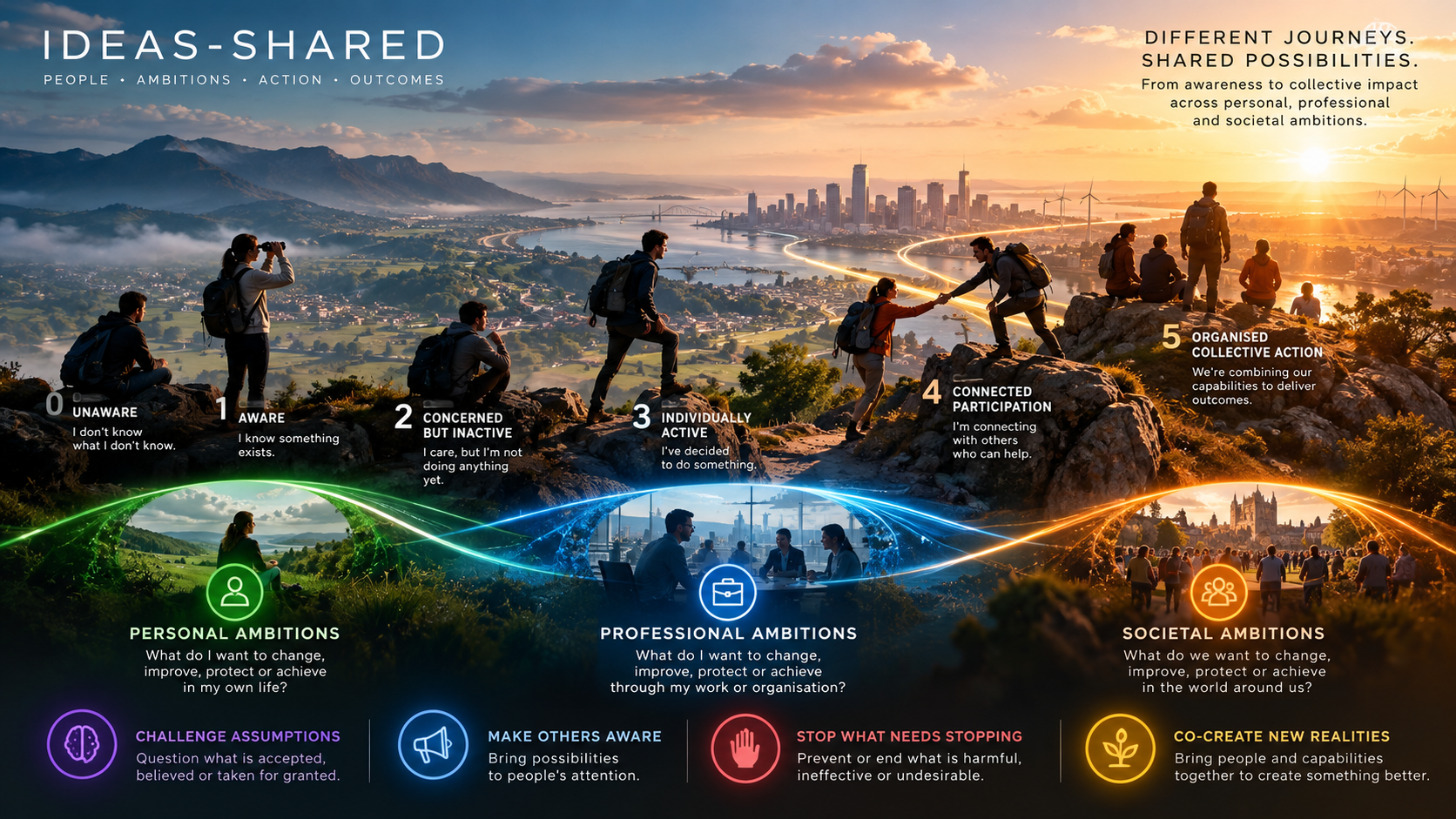
Different journeys. Shared possibilities.
Every day, billions of people go about their lives surrounded by challenges, opportunities and possibilities they may never fully recognise.
Some are personal. A better quality of life, improved health, financial security, new skills or ambitions that have been quietly put aside.
Others are professional. Inefficient working practices, missed opportunities, poor decisions, frustrated employees, unrealised innovation or organisations struggling to achieve what they know should be possible.
And then there are the challenges facing society. Economic inequality, environmental degradation, struggling public services, political division, community decline and systems that seem increasingly disconnected from the people they are supposed to serve.
These are not separate worlds. They overlap, interact and influence one another.
Yet there is a common problem running through all three.
People cannot act upon what they do not recognise, cannot pursue what they do not believe is possible, and cannot combine their capabilities with others they do not know exist.
This is the participation gap.
And it is much bigger than most people realise.
The Problem Starts Before Participation
We tend to think of participation as something that happens when people attend meetings, join groups, complete surveys, volunteer, contribute ideas or become involved in organised activities.
But what happens before any of that?
Consider someone living in a community where a public service is deteriorating.
They may not realise that the service is under threat. They may know something is wrong but not understand why. They may be concerned but believe nothing can be done. They may have ideas but no way of sharing them. They may be willing to help but have no idea who else feels the same way.
Meanwhile, hundreds or thousands of other people could be experiencing the same situation.
Some might have relevant knowledge. Others might have practical solutions, professional expertise, useful contacts or resources. A few might already be doing something about it.
But they remain disconnected.
The problem is not necessarily a lack of concern, intelligence, goodwill or capability.
It is that the conditions for effective participation have not been established.
And the same pattern repeats itself in businesses, communities, public institutions and personal lives.
Six Levels of Participation
At Ideas-Shared, we believe participation needs to be understood from the very beginning, not simply from the moment someone becomes involved.
That is why we have developed the Ideas-Shared Participation Framework.
It identifies six levels that describe how people relate to a particular ambition, challenge or opportunity.
The Ideas-Shared Participation Framework
From unawareness to organised collective action…
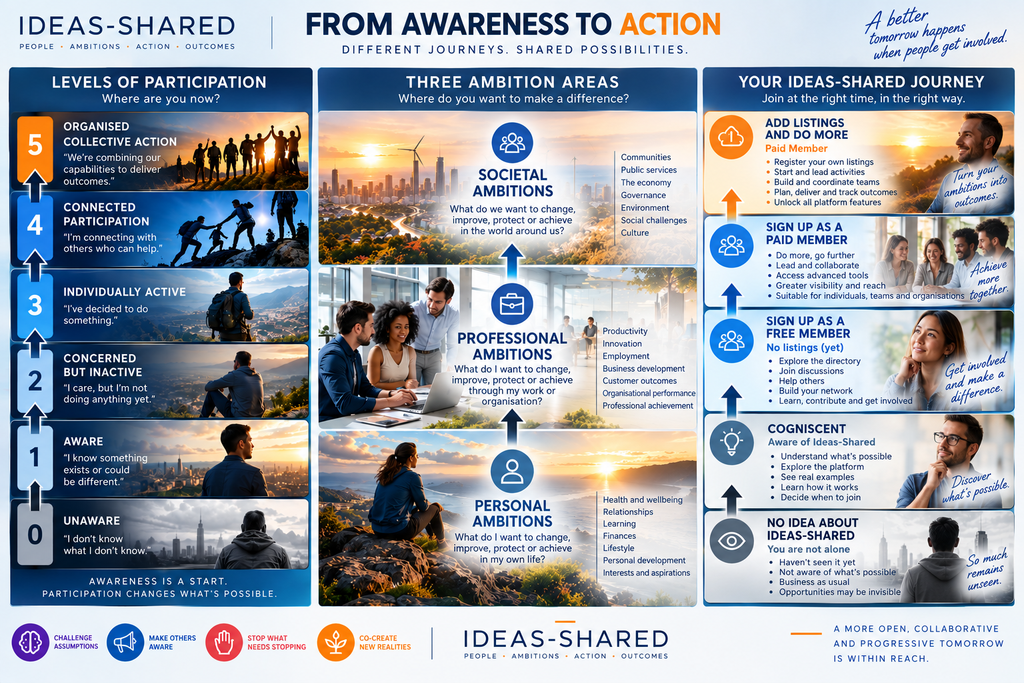
These levels are not a judgement of someone’s value, intelligence or commitment.
They describe where someone currently stands in relation to a particular ambition.
A person might be actively organising a community initiative while remaining completely unaware of an opportunity to improve their financial circumstances.
A business owner might be leading major organisational change while feeling powerless to influence wider societal conditions.
Someone else might have a personal ambition they can achieve independently, without needing to involve anyone else.
There is no single participation level that defines a person.
And there is no requirement for everyone to reach the highest level.
The purpose is to understand where people are, what they want, and what could help them move forward.
Three Ambition Areas. One Connected World.
Participation also needs to reflect the different areas of our lives.
Ideas-Shared recognises three primary ambition areas.
Personal ambitions
What do I want to change, improve, protect or achieve in my own life?
This could involve health, relationships, learning, finances, lifestyle, interests, personal development or a long-held aspiration.
Professional ambitions
What do I want to change, improve, protect or achieve through my work or organisation?
This might involve productivity, innovation, business growth, customer outcomes, employment, organisational effectiveness or professional achievement.
Societal ambitions
What do we want to change, improve, protect or achieve in the world around us?
This includes communities, public services, the economy, governance, environmental conditions, culture and the wider challenges and opportunities facing society.
These areas are connected.
A societal challenge can affect someone’s professional circumstances. A professional opportunity can transform someone’s personal life. An individual ambition can grow into an initiative that benefits an entire community.
Traditional structures frequently separate these areas.
People are placed into different systems, institutions, organisations and networks, often with little opportunity to connect their ambitions or capabilities across those boundaries.
Ideas-Shared is designed to make those connections possible.
Awareness Is Not the Same as Action
We live in an age of extraordinary information availability.
News, social media, research, reports, campaigns, conferences and public debate constantly expose us to problems and possibilities.
But information alone does not produce outcomes.
Knowing that something is wrong does not mean knowing how to change it.
Knowing that an opportunity exists does not mean knowing how to pursue it.
And knowing that other people are concerned does not mean having a practical way to organise with them.
Consider how much time is spent discussing economic problems, political disagreements, environmental challenges and organisational failures.
The arguments continue. Positions become entrenched. Blame circulates. People become frustrated.
Yet the fundamental questions often remain unanswered.
What do we actually want instead?
What alternatives are possible?
Who agrees?
Who is willing to help?
What capabilities are available?
And what are we going to do?
Without answers to these questions, awareness can become an endless cycle of observation, discussion and frustration.
Participation creates the opportunity to move beyond that cycle.
Four Reasons to Participate
Ideas-Shared recognises four fundamental intents behind participation.
These apply equally to personal, professional and societal ambitions.
Challenge Assumptions
Question accepted thinking, established practices and beliefs that may be preventing progress.
Why must something continue as it is? What evidence supports the current approach? What alternatives have not been considered?
Make Others Aware
Bring challenges, opportunities, information and possibilities to the attention of people who may otherwise never encounter them.
Sometimes progress begins simply because someone discovers that an issue exists or that a different outcome is possible.
Stop What Needs Stopping
Challenge, prevent or bring an end to practices, activities or conditions considered harmful, ineffective or undesirable.
Participation is not always about creating something new. Sometimes the ambition is to prevent something from happening or to bring an existing situation to an end.
Co-Create New Realities
Bring people, ideas, knowledge, resources and capabilities together to achieve something that might otherwise remain beyond reach.
This is where individual ambition can become collective capability.
These four intents are not mutually exclusive.
Challenging an assumption may reveal an opportunity. Making others aware may attract supporters. Stopping an undesirable practice may create the conditions for something better.
One activity can lead naturally to another.
The Missing Ingredient Is Often Connection
Imagine a thousand people who want to improve the same condition.
They may live in different places, work in different industries, belong to different organisations and have very different levels of knowledge and experience.
Some have ideas. Some have resources. Some have influence. Some have time. Some have practical skills.
Others simply care enough to contribute.
Individually, their capabilities may be limited.
Together, those capabilities could become significant.
But only if they can discover one another, understand what they share and organise their efforts.
That is why participation needs more than a discussion platform, a social network, a suggestion scheme or a project management tool.
It needs a practical mechanism that connects ambition with activity and delivery.
And that mechanism must be accessible to individuals, informal groups and organisations alike.
Joining Should Begin With Understanding, Not Selling
There is another problem with conventional participation platforms.
People are frequently asked to register, subscribe or purchase a membership before they fully understand what the platform could help them achieve.
But someone who has never encountered Ideas-Shared has different needs from someone who already has an ambition and wants to organise a team.
One person may simply want to explore.
Another may want to help others.
Another may want to initiate their own activities.
An organisation may want to bring its employees, customers, suppliers, members or supporters together.
These are different starting points, not necessarily different levels of commitment.
The Ideas-Shared Participation Framework helps people recognise where they are and understand what they might want to do next.
Our membership journey is designed around that principle.
People can discover what is possible, explore ambitions, participate in the activities of others and choose the membership capabilities appropriate to their own requirements.
Those who want to initiate and lead their own activities can access the relevant paid membership options.
Those who need to operate through teams or organisations can explore the appropriate account structures and participation infrastructure.
The important point is that people make informed decisions based on what they want to achieve.
Membership should enable participation, not become an obstacle to discovering it.
From Participation to Outcomes
Ideas-Shared brings these elements together through a simple, repeatable operating model.
Start with an ambition.
Choose an activity.
Make it visible.
Bring others in where useful.
Organise what needs doing.
Take action.
Deliver an outcome.
The platform supports 19 activity types, allowing people to begin with something familiar, whether that is an idea, question, problem, solution, discussion, event, announcement, request for help or a declared ambition.
Not every activity needs a formal team. Not every ambition requires a complex plan. Not every outcome needs hundreds of participants.
The mechanism should fit the activity, rather than forcing every activity into the same structure.
And participation should not end when an outcome is delivered.
One successful activity can create new awareness, reveal further opportunities, attract additional participants and inspire entirely new ambitions.
This is how participation can become self-reinforcing.
What Happens When Participation Becomes Normal?
Consider the possibilities if participation becomes an everyday activity rather than an occasional response to a crisis.
Individuals could find people who share their ambitions.
Businesses could discover opportunities and capabilities beyond their existing organisational boundaries.
Communities could organise around the conditions they want to improve.
Public institutions could engage with people who are willing to contribute, not simply those who want to complain.
And society could develop a greater capacity to identify shared ambitions and coordinate action across traditional divisions.
The value would not come simply from having more members on a platform.
It would come from the ambitions pursued, the connections made, the activities undertaken and the outcomes delivered.
There is no guarantee that every ambition will succeed.
But making participation more accessible, visible and organised creates opportunities that may never arise when people remain unaware, isolated or inactive.
A Better Tomorrow Happens When People Get Involved
The future is not something that happens entirely beyond our influence.
Across our personal lives, professional activities and wider society, there are conditions we can question, improve, protect, stop or create.
We do not all need to agree.
We do not all need the same ambitions.
And we do not all need to participate in the same way.
But we do need practical opportunities to discover what matters, understand what is possible, find others and act.
That is the purpose of the Ideas-Shared Participation Framework.
And it is the reason Ideas-Shared exists.
Awareness is a start. Participation changes what’s possible.
Explore the Ideas-Shared Participation Framework
Discover where you are, what you want to achieve and how you can participate.