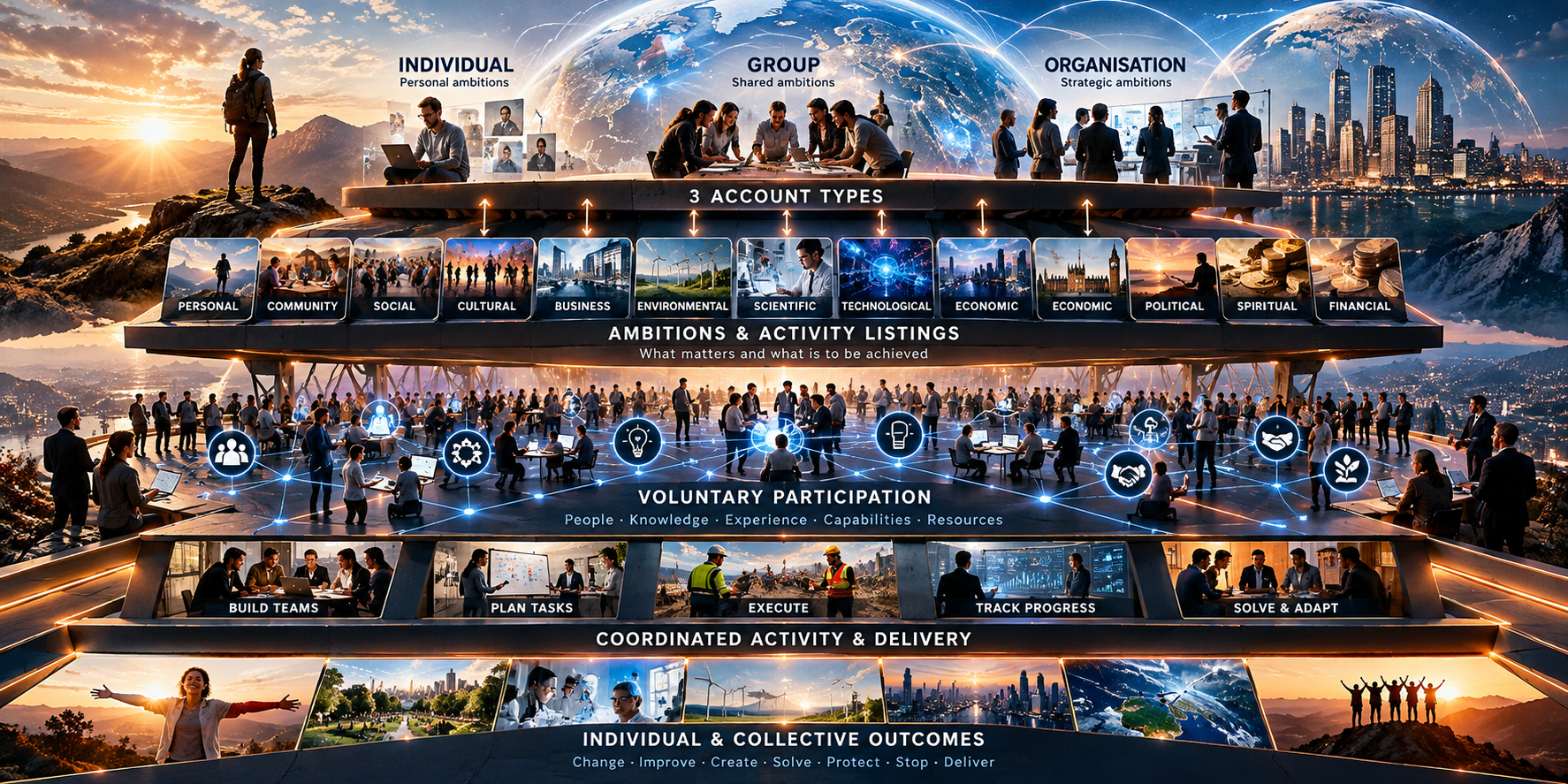
The internet connected the world. What happens when we organise that connectivity around the ambitions people want to achieve?
The Internet Changed How We Connect. But What About What We Achieve?
The internet has transformed almost every aspect of modern life.
Billions of people can communicate instantly, share information, exchange ideas, conduct business, learn, debate, entertain themselves and form relationships across geographical and organisational boundaries.
We can reach people on the other side of the world as easily as someone in the next street.
And yet, despite this extraordinary connectivity, countless ambitions remain unrealised.
Problems persist. Opportunities are missed. Good ideas go nowhere. People struggle with challenges that others could help resolve. Organisations duplicate effort. Communities lack resources. Valuable knowledge, experience and capability remain disconnected from where they could make a difference.
Not necessarily because solutions don’t exist.
But because being connected isn’t the same as being organised to achieve something.
And that distinction matters.
From One-to-One Connections to One-to-Many Participation
Much of our experience of the internet is personal.
We search for information. We contact someone. We follow an account. We respond to a post. We make a purchase. We join a conversation.
Of course, the internet already enables communities, networks and large-scale collaboration.
But what if we made something different the organising principle?
Not the person. Not the organisation. Not the content. The ambition.
Imagine an individual identifying something they want to achieve.
It might be a personal challenge, a business opportunity, a community improvement, an environmental concern, a scientific question or a societal problem.
They make that ambition visible.
Now imagine other people discovering it.
Some offer knowledge. Others contribute experience. Someone identifies a solution. Another provides resources. A business offers assistance. An organisation brings specialist capability. A group volunteers to help.
People who may never have met, worked together or even known of one another’s existence begin contributing towards an outcome.
One ambition. Many potential participants.
One to many.
Now imagine every participant having exactly the same opportunity to initiate ambitions of their own.
And every one of those ambitions being capable of attracting its own participants.
Many times over.
That is the principle at the heart of Ideas-Shared.
Three Account Types. Unlimited Possibilities.
Ideas-Shared was designed around three types of account:
- Individuals — people pursuing personal, professional or societal ambitions.
- Informal groups — people coming together around shared interests, concerns, opportunities or objectives.
- Organisations — businesses, charities, institutions, public bodies and other established entities pursuing their own ambitions or supporting those of others.
Each can initiate activities.
Each can participate in activities initiated by others.
And each can engage across multiple activities simultaneously.
An individual might be developing a business, supporting a community project, contributing to a scientific initiative and helping someone overcome a personal challenge.
An organisation might be pursuing commercial opportunities while supporting environmental improvements, contributing specialist expertise to community activities and collaborating with other organisations.
An informal group might initiate a local project that eventually attracts national or international participation.
There is no requirement for these people or organisations to belong to the same network, share the same background or have an existing relationship.
What brings them together is the ambition and their voluntary decision to participate.
Collaboration Without Conventional Boundaries
Traditionally, getting things done often depends on established structures.
Organisations have departments. Communities have committees. Projects have appointed teams. Institutions operate within defined jurisdictions. Businesses develop formal partnerships.
These arrangements can be valuable and necessary.
But they can also limit who participates, how quickly people come together and which capabilities become available.
Ideas-Shared introduces another possibility.
Collaboration can emerge around the activity itself.
It can be local, regional, national or international.
It can involve people within an organisation, outside it or across multiple sectors.
It can be temporary, ongoing, informal or highly structured.
It can involve two people or potentially millions.
And participants can move between activities, contribute in different capacities and establish entirely new relationships as opportunities emerge.
The organising structure can reflect what the ambition requires, rather than the ambition being constrained by an existing structure.
We don’t have to reorganise the world before people can begin working together.
We need to make it easier for people to find one another, combine their capabilities and act.
The Ambition Belongs to Its Initiator. Performance Can Be Collective.
This is an important distinction.
Every Ideas-Shared activity begins with an account holder — an individual, informal group or organisation.
They identify what matters, establish the ambition and create the activity listing.
But initiating an ambition doesn’t mean possessing everything needed to achieve it.
Nor does it mean having to do everything personally.
Consider a small business seeking to develop a new product.
The owner understands the opportunity but lacks technical expertise, manufacturing contacts or access to particular markets.
Elsewhere, individuals and organisations possess those capabilities.
Or consider a community facing a persistent local problem.
Residents understand the circumstances, but solutions may require knowledge, resources and cooperation from people far beyond their immediate community.
Or consider someone with an idea capable of improving lives internationally.
The idea may originate with one person, but its development and implementation could require contributions from hundreds or thousands.
In each case, the ambition has an initiator.
But its progress and achievement may depend on the combined efforts of many.
And those contributions need not be equal or identical.
One person may contribute an hour. Another may provide months of expertise. An organisation may supply resources. Someone else may challenge an assumption that changes the entire approach.
Each contribution can matter.
The outcome is what brings their efforts together.
From Participation to Delivery
Of course, bringing people together is only part of the challenge.
Discussion alone doesn’t guarantee progress.
Good intentions don’t automatically produce results.
That is why Ideas-Shared goes beyond making ambitions visible.
Its seven-step operating model enables participants to:
- Register an ambition.
- Create an activity listing.
- Share the listing and attract attention.
- Build a team.
- Plan the tasks.
- Execute the activity.
- Deliver outcomes and move forward.
Not every activity needs to progress through every stage.
Some exist to make others aware, challenge assumptions, raise questions, share knowledge or encourage participation.
Others require coordinated teams, resources, plans and sustained execution.
And not every activity will achieve everything originally intended.
Some will succeed completely. Others partially. Some will change direction, reveal new possibilities or establish that an alternative approach is needed.
But the opportunity remains the same.
Move beyond connection and conversation towards purposeful participation and meaningful progress.
Now Multiply That Across the World
Here is where the potential becomes extraordinary.
Imagine one million people using Ideas-Shared.
Now imagine each initiating just one ambition.
That’s one million ambitions.
But those members are not limited to pursuing their own activities.
Each can discover, support or contribute to ambitions initiated by others.
Some activities may attract only a handful of participants.
Others could involve hundreds, thousands or even millions.
Some may be completed in days. Others may take years.
Some will generate entirely new ambitions.
A solution developed for one problem might help solve another.
A relationship formed during one activity might lead to an unexpected opportunity.
A resource made available for one project might unlock several others.
Knowledge gained through one experience might prevent mistakes elsewhere.
And participation isn’t limited to those who initiate the activities.
Individuals, groups and organisations can continually enter, contribute, collaborate and create new possibilities.
One to many. Many times over.
Not as a single campaign, project or organisation.
But as an ongoing capability available across personal, professional and societal life.
We cannot predict the outcomes.
That’s precisely the point.
The possibilities emerge from what people choose to initiate, who chooses to participate and what they accomplish together.
The Network Is Not the Achievement
There is a tendency to judge digital platforms by their size.
How many users?
How many followers?
How many posts?
How much engagement?
But those measures tell us relatively little about what people actually achieve.
A network containing millions of people may produce very little meaningful progress.
A much smaller network, organised around purposeful activities, could produce extraordinary results.
For Ideas-Shared, membership is an enabler, not the ultimate measure of success.
What matters is what participation makes possible.
How many ambitions are being pursued?
How many challenges are being addressed?
How many people and organisations are contributing?
How much progress is being made?
What outcomes are being delivered?
And how do those outcomes improve conditions for the people involved and the wider world?
The value of the network lies not simply in who belongs to it, but in what becomes possible through their participation.
Everyone Can Initiate. Everyone Can Contribute.
Perhaps the most important characteristic of Ideas-Shared is that participation is not reserved for people with authority, wealth, influence or established networks.
Every member has the opportunity to decide what matters to them.
Every member can initiate ambitions.
Every member can discover activities that interest them.
Every member can choose where, when and how to contribute.
Nobody needs permission to have an ambition.
And no individual or organisation has to wait for a central authority to decide which ambitions deserve attention.
People can challenge assumptions, make others aware, stop what needs stopping and co-create new realities.
Individually and collectively.
Locally and globally.
As often as they choose.
This doesn’t mean every ambition will attract support, every proposal will prove worthwhile or every collaboration will succeed.
It means the opportunity to initiate, participate and pursue outcomes is opened up to everyone.
Personal sovereignty becomes collective capability.
What Could We Achieve Together?
The internet gave us unprecedented connectivity.
Ideas-Shared was created to help turn that connectivity into coordinated participation and outcomes.
Not by replacing existing organisations, communities or relationships.
But by making it possible for people to work across them, beyond them and between them.
An ambition may begin with one person.
Its achievement may depend on many.
And every participant may simultaneously be pursuing ambitions of their own.
Multiply that across individuals, informal groups and organisations, across every area of life, and across the world.
What emerges is not simply another network.
It is an expanding infrastructure for people to identify what matters, combine their capabilities and get things done.
No one can know in advance what everyone might initiate, who might participate or what they might achieve.
But we can create the conditions that make those possibilities available.
One to many. Many times over.
That’s what Ideas-Shared was built to make possible.