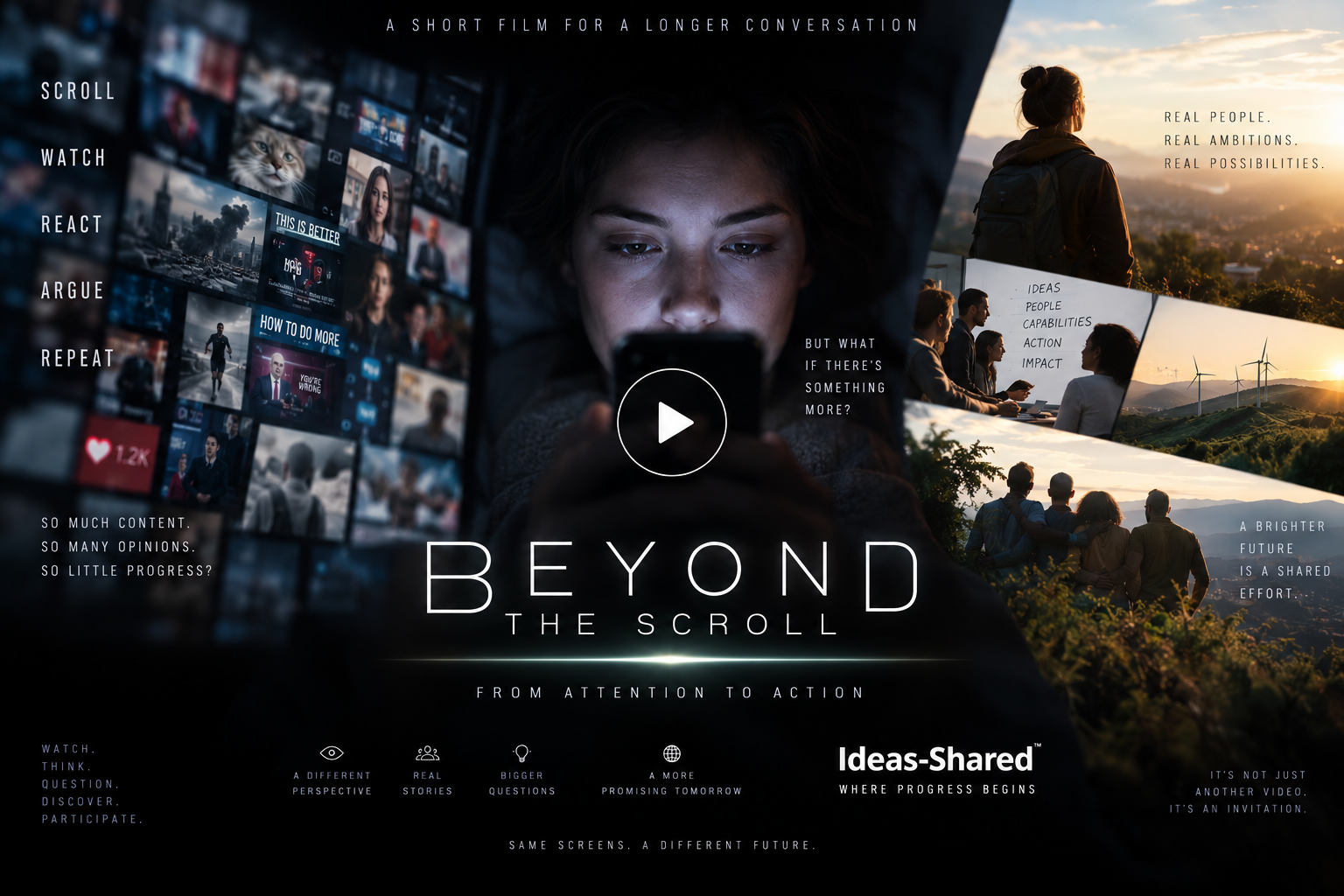
We have never had so much content, so much entertainment, or so many ways to occupy our minds. Yet perhaps the most interesting thing we could discover is not another video, post or opinion — but what we might actively do together.
We scroll. And scroll. And scroll some more.
A video catches our attention. Someone makes us laugh. Someone makes us angry. Someone offers an opinion. Someone challenges it. A remarkable achievement. A terrible injustice. A clever idea. A beautiful place. A political argument. A celebrity. A cat.
Ten seconds. Thirty seconds. Two minutes. Next.
There is always another post, another video, another headline, another argument, another person with something to say. The content never ends, and increasingly, the platforms we use are extraordinarily good at keeping us there.
But here’s a question worth asking. When we finally put the phone down, what have we actually gained?
And perhaps an even more important question: How long before even the most extraordinary content fails to excite us anymore?
The Most Extraordinary Entertainment Machine Ever Created
We have built an astonishing global content machine. Billions of people can publish their thoughts, experiences, knowledge, opinions, creativity and achievements almost instantly. Anyone can become a broadcaster. Anyone can find an audience. Anyone can discover things they might never otherwise encounter.
That is an extraordinary human achievement, and there is nothing inherently wrong with entertainment. We need laughter, relaxation, distraction and opportunities to escape the demands of everyday life. A funny video can brighten a difficult day. An inspiring story can change someone’s outlook. A useful explanation can solve a problem. A new perspective can challenge a deeply held assumption.
Content has genuine value.
But something interesting happens when extraordinary experiences become available to us continuously. What once amazed us becomes familiar. What once captured our imagination becomes just another thing we’ve seen. What once seemed impossible becomes something we watch for a few seconds before moving on.
The extraordinary gradually becomes ordinary, and the ordinary becomes increasingly difficult to tolerate.
Think about the first time you encountered something truly remarkable online. Perhaps it was an extraordinary feat of human achievement, a breathtaking landscape, an invention that seemed impossible or a story that changed how you thought about the world. You stopped, watched, thought about it and perhaps even told someone else.
Now imagine encountering hundreds of extraordinary things every day.
Another remarkable achievement. Another breathtaking landscape. Another technological breakthrough. Another inspirational story. Another extraordinary person doing something extraordinary.
At first, the abundance is exhilarating. But the more we consume, the more familiar even the exceptional can become. The next video needs to be funnier, the next achievement more remarkable, the next revelation more surprising and the next controversy more outrageous.
Not necessarily because the content is becoming less interesting, but because our expectations are changing. We have already seen so much, and so the search continues for something new, different or better. Something that might restore the excitement we once experienced so easily.
But what happens when the excitement we’re searching for becomes increasingly difficult to find?
When Nothing Quite Moves Us Anymore
There may be something more concerning than the amount of time we spend consuming content. What happens when we become so accustomed to seeing everything that eventually, almost nothing moves us?
A war. A disaster. An injustice. A remarkable invention. An extraordinary human achievement. Someone asking for help. Someone offering hope.
All reduced to another item in an endless stream.
We see it. We react, perhaps. And we scroll.
The shocking becomes familiar. The inspiring becomes momentary. The extraordinary becomes expected. Not necessarily because we no longer care, but because there is simply too much to absorb, too much to process and too little opportunity to do anything meaningful with what we encounter.
We may begin to experience the world as spectators to almost everything. We know more about its problems than ever before, yet can feel increasingly disconnected from our ability to influence them. We encounter extraordinary human achievements, yet may become less inclined to pursue something ourselves. We see countless appeals for help, but without a clear way to contribute, even our willingness to respond can begin to fade.
And eventually, perhaps, we start questioning the experience itself.
Why am I watching this? What am I looking for? Haven’t I seen something like this before? Is there really nothing better I could be doing with my time?
What if the infinite scroll doesn’t just consume our attention? What if it gradually diminishes our capacity to find excitement, meaning and possibility in what we see?
When the Infinite Scroll Becomes an Infinite Argument
But the endless stream isn’t simply entertainment. It is also an extraordinary conveyor belt of opinions, ideologies, arguments, grievances, accusations, justifications and competing versions of reality.
Someone tells us what is wrong with the world. Someone else tells us who is responsible. Another explains why the first person is wrong. Another offers a justification. Another demands that we take a side. And another insists that unless we agree, we must somehow be part of the problem.
Politics, economics, business, society, culture, the environment and our personal lives. Almost everything becomes a subject for disagreement, blame or division.
The arguments arrive continuously, often accompanied by carefully selected evidence, emotional language, selective comparisons and confident assertions about what must happen next. And because the next argument is only a swipe away, there is rarely any requirement to resolve the previous one.
We can become absorbed in disputes that have no clear destination. We can spend hours considering who is right, who is wrong, who is responsible and who deserves our anger. We can find ourselves defending positions we had never previously considered, adopting the language of people we have never met and becoming emotionally invested in conflicts over which we have little direct influence.
And then, having exhausted ourselves with one argument, we encounter another.
The anger can linger long after the content has disappeared. The frustration can influence how we see other people. The constant exposure to disagreement can make the world appear more divided, more hostile and less capable of finding common ground than our everyday experiences might otherwise suggest.
Yet what happens afterwards? Has the problem been solved? Have conditions improved? Has anyone established what a better outcome would actually look like? Has anyone identified who is willing and able to help deliver it?
Or have we simply contributed another reaction to an argument that will continue tomorrow?
We have become extraordinarily good at distributing disagreement. But where is the equivalent infrastructure for organising progress?
The Endless Supply of Answers Nobody Has Proven
Alongside the arguments comes another seemingly inexhaustible stream: advice.
How to become more productive. How to become wealthier. How to build a business. How to improve your health. How to manage people. How to fix the economy. How to transform society. How to live a better life.
Someone always has an answer, a method, a course, a framework, a strategy, a formula or a supposedly revolutionary approach. And the next person has something better.
The claims can be compelling. The presentation can be polished. The confidence can be extraordinary. But how often do we stop to ask whether the promised outcomes have actually been achieved?
Under what circumstances? For whom? At what cost? Compared with what alternative? And can the results be independently established?
Advice, experience and new thinking can be enormously valuable. But there is a difference between a plausible proposition and a demonstrated outcome, just as there is a difference between someone explaining how something should work and establishing that it actually does.
Much of what we encounter online is not accompanied by the evidence needed to distinguish between the two.
An assertion becomes a post. A post becomes a conversation. A conversation becomes a widely repeated belief. And repetition can begin to resemble validation.
Meanwhile, another person arrives with another answer.
The result can be a bewildering accumulation of competing instructions about how we should live, work, think, behave, organise and improve ourselves. We can spend so much time absorbing advice about what we ought to do that we have comparatively little time left to discover what actually works for us.
What if we became less interested in what people claim will work and more interested in what we can actually establish, test, improve and deliver?
An Environment Where Attention Is Measured More Easily Than Progress
Consider the extraordinary sophistication of the systems surrounding digital content. Views, clicks, likes, shares, followers, impressions, engagement, watch time and reach. Almost everything associated with attracting and retaining attention can be measured.
But what about the outcomes?
Did the argument lead to a resolution? Did the advice improve someone’s circumstances? Did the proposed solution work? Did the campaign achieve its objective? Did the activity create lasting value? Did the people involved become better equipped to achieve something else?
These questions are much harder to answer.
Digital platforms are not entirely unregulated, and some have introduced safeguards, transparency measures and fact-checking arrangements. But the wider environment remains unevenly governed, with no universal requirement for publishers to demonstrate that their claims produce the outcomes they promise.
A piece of content can attract millions of views without establishing whether it has improved anything. An argument can generate extraordinary engagement without bringing anyone closer to agreement or resolution. An idea can become popular without ever being tested. And a genuinely valuable contribution can disappear almost unnoticed.
The systems can tell us how many people watched, reacted and shared. They are often much less capable of telling us what those people subsequently achieved.
We have developed increasingly sophisticated ways of measuring attention, without an equivalent universal mechanism for measuring the progress that attention produces.
Popularity is not proof. Engagement is not progress. Agreement is not achievement. And visibility is not value.
Perhaps we need to become considerably more interested in what happens after the attention has been captured.
The Moment We Start Questioning Our Time
Perhaps the most interesting development will not be another technological breakthrough. Perhaps it will be a change in how we think about our own attention.
There may come a point when the next video, the next post and the next fleeting moment of entertainment simply aren’t enough. Not because we’ve exhausted the internet — that would be impossible — but because we’ve begun to question what we’re getting from it.
Another hour has passed. Another hundred posts have disappeared beneath our fingers. We’ve laughed, been surprised, informed, irritated and entertained. We’ve encountered problems, solutions, arguments, achievements and opinions from across the world.
But what has actually changed?
What have we created? What have we contributed? What have we discovered that matters beyond the moment? What have we done that might make tomorrow different from today?
And how much of our time have we spent responding to things that somebody else decided should occupy our attention?
Perhaps the question will no longer be whether the next piece of content is worth watching.
Perhaps it will be whether watching content is the most interesting thing we could be doing with our lives.
And that is where an entirely different possibility begins.
When Do We Take Our Agency Back?
At some point, we need to ask a question that goes beyond content, technology and social media.
Who is deciding what occupies our minds? Who is deciding which problems deserve our attention? Who is determining which arguments we encounter? Who is telling us what success should look like?
And how much of our time are we spending reacting to priorities established by somebody else?
Every day, we encounter attempts to influence what we think, what we buy, what we believe, what we fear, what we admire and what we should want next. Some are useful. Some are well-intentioned. Some are commercially motivated. Some are ideological. Some are simply competing for attention.
But collectively, they can occupy an extraordinary amount of our mental space.
We may become so accustomed to responding to the world as it is presented to us that we spend comparatively little time deciding what we want from it ourselves.
And there is an important distinction here. Having access to endless information does not necessarily mean we are exercising greater agency. Being able to express an opinion does not necessarily mean we are influencing an outcome. Being invited to choose between competing narratives does not necessarily mean we are deciding what matters to us.
We can be extraordinarily active online while remaining remarkably passive in relation to the conditions of our own lives.
So perhaps the most important questions are also the simplest.
What matters to me? What do I want to change? What do I want to improve? What do I want to stop? What do I want to protect? What do I want to create? What do I want to achieve?
These are fundamentally different questions from asking what we should watch, read, believe or react to next.
They return the starting point to us.
Taking back our agency begins when we stop allowing the endless stream of other people’s priorities to substitute for deciding our own.
Why Taking Back Our Agency Matters
Personal agency is not simply about having opinions. It is about recognising that we have the capacity to make choices, initiate activities, influence circumstances and contribute to outcomes.
We cannot control everything. We cannot solve every problem. We cannot always achieve what we want. But neither are we limited to observing, reacting and waiting for somebody else to act.
We can decide what matters, make our ambitions visible, seek knowledge, challenge assumptions, discover people who share our interests and combine capabilities. We can initiate something. We can participate in something. We can help make something happen.
And when we encounter circumstances beyond our individual capabilities, we can look for others who might voluntarily combine their capabilities with ours.
This is where personal agency becomes something much more powerful.
Every person has sovereign power to decide what matters. When we combine that power intelligently with others, personal, professional and societal ambition becomes collective capability.
Imagine the difference between millions of people endlessly reacting to the same problems and millions of people discovering opportunities to do something about the conditions that matter to them.
Not necessarily agreeing about everything. Not surrendering their independence. Not waiting for permission to begin. But choosing where and how to contribute.
The opportunity is not to replace one set of instructions with another, or to persuade everyone to pursue the same vision of the future. It is to give people the means to pursue their own ambitions and discover where those ambitions intersect with the interests and capabilities of others.
That is not simply a different way to use technology.
It is a different relationship with the world around us.
Imagine a Different Kind of Digital Experience
Now imagine opening a platform and discovering that someone has an ambition remarkably similar to your own.
Someone wants to improve a local community. Someone wants to start a business. Someone has identified a problem in their industry. Someone has an idea that could improve healthcare. Someone wants to protect something precious. Someone wants to challenge an assumption that has gone unquestioned for decades.
Someone has a solution but lacks the people, knowledge or resources to make it happen.
And you realise that you might be able to help.
Perhaps you know someone. Perhaps you have relevant experience. Perhaps you have an idea, access to a resource or a perspective that nobody else has considered. Perhaps you simply agree that something needs to change.
Suddenly, you’re no longer just watching. You’re thinking, imagining, making connections, considering possibilities and wondering what might happen next.
And then something even more interesting occurs.
Other people join in. Someone contributes knowledge. Someone challenges an assumption. Someone offers a solution. Someone identifies an opportunity nobody else had considered.
An ambition begins to take shape. A team forms. Things start happening. Results become visible.
And now you have a reason to return.
Not because an algorithm has found another way to capture ten seconds of your attention, but because something you care about is actually progressing.
The experience has become personal. You have a stake in what happens next. Your contribution might make a difference, and the contributions of others might reveal possibilities you could never have discovered alone.
What could possibly keep us more engaged than discovering what we might actively do together?
Attention Is Finite. Ambition Is Not.
Much of the digital world competes for attention. Ideas-Shared starts somewhere else.
With ambition.
What do you want to change, improve, stop, protect, create or achieve? What matters to you? What would you like to see happen? What could become possible if you found other people who cared about the same things?
These questions apply to every area of life. Personal, professional and societal. They apply to individuals, informal groups, businesses, charities, communities, public bodies and governments. They apply to ambitions that require one person to help and ambitions that might eventually involve millions.
And they create a fundamentally different reason for using a digital platform.
Not simply to discover what other people are saying, but to discover what people want to achieve, what capabilities exist, where opportunities lie and what might become possible through voluntary participation.
The content itself is no longer the destination. It becomes the beginning of something.
A thought can become a conversation. A conversation can become a connection. A connection can become an activity. An activity can become an outcome. And an outcome can create new possibilities.
This is not about keeping people permanently attached to their screens. It is about giving their time online a purpose that extends beyond the screen and into the world around them.
And unlike the search for ever more extraordinary content, the possibilities need not become exhausted through familiarity. Every new ambition introduces different circumstances. Every new connection brings different capabilities. Every new activity creates opportunities to discover something we didn’t previously know.
The excitement no longer depends on finding something increasingly extraordinary to watch.
It comes from discovering what might become possible through our own participation.
Imagine the Possibilities at Scale
Now imagine millions of people participating in this way.
Not necessarily in the same activities, pursuing the same ambitions or agreeing about everything, but making their ambitions visible, discovering opportunities, finding one another and combining their capabilities where it makes sense.
Imagine the knowledge that could be shared, the relationships that could form, the assumptions that could be challenged and the resources that could be connected. Imagine the problems that could be solved, the businesses that could be created, the communities that could be improved and the personal ambitions that could finally become achievable.
And imagine the cumulative effect of all those activities taking place across the world.
Not through one centrally directed programme. Not because everybody has to agree. But because people are free to decide what matters, initiate activities and voluntarily combine their capabilities with others.
Personal sovereignty becoming collective capability.
The potential isn’t limited to the number of people participating. It also depends on the connections, opportunities and combinations of capability that participation makes possible.
Nobody can know in advance what those combinations might produce, which conversations might unlock opportunities or which seemingly impossible ambitions might become achievable.
That is part of what makes the opportunity so compelling.
What If Hope Became Something We Could Participate In?
Hope is an interesting thing.
We often look for it in speeches, promises, inspirational stories and visions of a better future. But hope can also emerge from something much more tangible.
Seeing someone take the first step. Discovering that others share your ambition. Finding a capability you didn’t know existed. Watching an idea develop. Seeing people work together. Witnessing an outcome that once seemed unlikely. And realising that you could be part of what happens next.
That is a very different experience from consuming another piece of content.
It gives optimism somewhere to go. It turns possibility into activity. It makes the future something we can help shape rather than simply wait for.
And perhaps this is what we have been missing in so much of our digital experience. Not information. Not entertainment. Not opinions. Not even inspiration.
But the means to do something meaningful with what we discover.
A way to move beyond observing the problems of the world and begin contributing to their resolution. A way to move beyond admiring the achievements of others and begin pursuing our own. A way to move beyond endlessly debating what should happen and discover who is willing to help make something happen.
Hope becomes more compelling when we can participate in creating the conditions that give us reason to hope.
The Next Great Digital Experience Might Not Be About Content at All
We don’t need to stop watching videos, abandon social media or reject entertainment and the extraordinary benefits of digital communication.
But we could ask more of the digital world.
What if the next great evolution of online engagement were not another way to occupy our attention, but a way to make better use of our ambitions? What if we could discover opportunities as easily as we discover videos? What if finding people who could help were as natural as following someone online?
What if we could move from an interesting thought to a meaningful activity without having to build everything from scratch? What if we had somewhere to return to because the things we cared about were progressing? And what if millions of people were doing the same?
That is the possibility behind Ideas-Shared.
A global participation environment where people can make ambitions visible, discover one another, combine capabilities, organise activities and pursue measurable outcomes.
Not another destination for endless consumption, but a place where participation can begin. Where ambition can become activity, activity can become progress and progress can create new possibilities.
The opportunity is not simply to capture more attention. It is to help people turn their attention towards the things they have chosen to care about, and give them practical means to act.
So, What Are We Actually Looking For?
The next time you find yourself scrolling, consider what it is you’re hoping to discover.
Entertainment? Information? Connection? Inspiration? Another argument? Another answer? Something that makes you feel the world isn’t quite as limited as it sometimes appears?
Perhaps you’ll find it.
But perhaps there is something even more compelling waiting beyond the next post.
An ambition that matters to you. An opportunity you didn’t know existed. Someone you could help. Someone who could help you. Something you could create, change, improve or achieve. Something worth returning to tomorrow because you helped move it forward today.
And perhaps, eventually, we will begin to ask a different question.
Not what else is there to watch? Not who should we agree with? Not who should we blame? Not what should we be angry about next?
But what do we actually want, what is possible, who else cares, and what might we actively do together?
We have spent decades building technologies that make it easier to consume what other people create, react to what other people say and follow priorities established by others.
Imagine what might happen if we became equally good at helping people establish their own priorities, discover one another and actively create the world they want to live in.
Perhaps the greatest opportunity isn’t to capture more of humanity’s attention.
It is to unlock more of humanity’s capability.
The infinite scroll asks for our attention.
The future needs our participation.
And perhaps it’s time we took our agency back.