
From political concern to collective action.
Politics shapes the conditions in which we live: the laws we follow, the services we rely on, the taxes we pay, the rights we hold and the decisions that affect our communities and future.
Yet many people experience politics as something done around them. Politicians say there is little they can do. Party lines and prepared rhetoric take the place of engaging with the issue. Responsibility for decisions—and for inaction—can be hard to pin down. People raise concerns and are sometimes judged by the label attached to their question before anyone addresses what they are asking.
This is not simply a problem of disagreement. People will always hold different views about what should change and how. The deeper problem is when political concern has no clear route into sustained public participation, practical action or accountability.
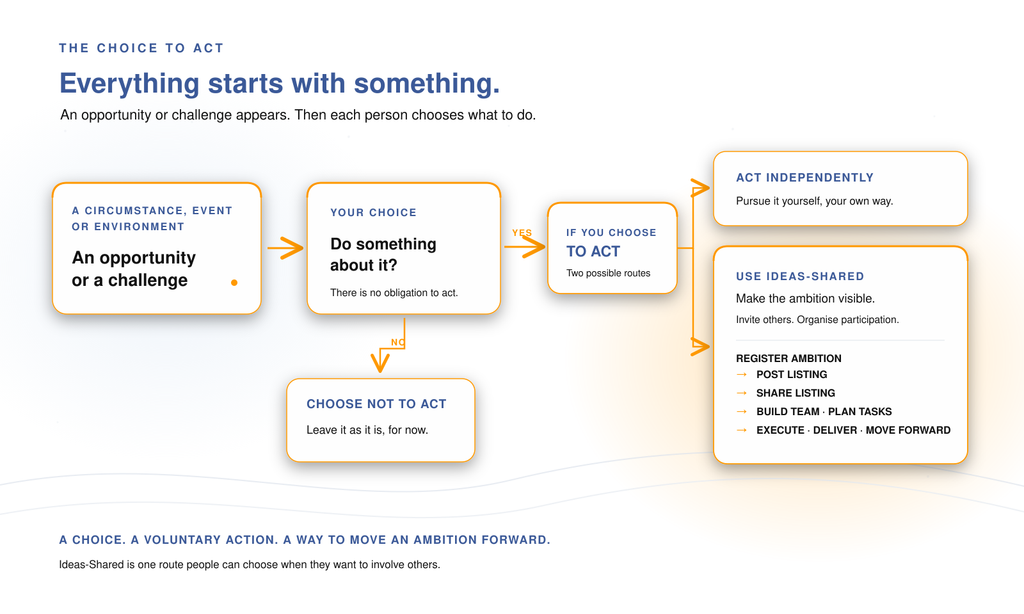
Every political ambition begins with a circumstance, event or environment. It may present an opportunity or a challenge. Each person decides whether to act. If they choose to, they can act themselves or use Ideas-Shared to involve others and organise what happens next.
When rhetoric replaces engagement
On difficult issues, political debate can move quickly from the substance of a question to the motives of the person asking it. Consider illegal immigration. People may want to examine border control, the rule of law, asylum processes, exploitation, pressure on local services, the treatment of people arriving, or confidence in government. These are distinct questions, with different evidence and possible responses.
Racism should be challenged wherever it appears. But a label cannot, by itself, answer a question about policy, evidence or consequences. If a claim is wrong, it can be examined. If a policy is failing, people can ask what should change. Dismissing the question leaves the underlying concern—and the people affected by it—unaddressed.
The same pattern can arise across political life: housing, taxation, public services, government accountability, environmental policy, rights, regulation, representation and more. When politicians say little can be done, people still have the right to ask what has been tried, what is preventing progress, what alternatives exist and who is accountable for action or inaction.
People can create another route to action
If established political channels do not lead to meaningful action, people do not have to wait for rhetoric to turn into results. They can act independently, or they can organise with others. At scale, many voluntary actions can create an alternative source of ideas, evidence, proposals, scrutiny, campaigns and practical solutions.
Mass alternative action does not require everyone to join one movement, adopt one ideology or agree on every issue. It can begin with one person and one ambition, then grow as others choose to contribute. People may share experience, provide evidence, challenge assumptions, explain another perspective, develop a proposal, contact a decision-maker, organise a campaign or complete a practical task.
Ideas-Shared is designed to help people who choose to act bring others into the work. It does not prescribe a party, ideology or policy answer. Members decide what matters to them and what they want to pursue.
From political ambition to organised activity
A political ambition describes what someone wants to change, improve, challenge, stop, protect or achieve in politics, government, public policy or civic life. A Listing makes the issue, question or desired outcome visible and gives other people a way to participate.
Ideas-Shared supports that participation through its seven-step process:
Register an Ambition → Post a Listing → Share the Listing → Build a Team → Plan Tasks → Execute → Deliver and Move Forward.
People can bring in those they know and reach others they have yet to meet. They can gather experience and evidence, develop ideas and alternatives, organise tasks and take practical action. Some ambitions may move forward through a single conversation or contribution. Others may call for sustained participation across a wider community.
This process does not guarantee that every institution will respond as people hope. It gives people a structured way to make an ambition visible, bring relevant capabilities together, pursue an outcome and make progress—or a lack of it—easier to see.
Politics should include people who choose to participate
People may decide not to act. Others may choose to pursue an ambition on their own. Those who want to involve others can use Ideas-Shared to make the ambition visible, invite participation and organise activity.
People do not have to agree about everything to work together on a particular question or outcome. They can challenge assumptions, make others aware, stop what needs stopping and co-create new realities—each choosing what matters to them and how they want to contribute.
When politics fails to address a condition, people still have a choice: leave it as it is, act independently, or bring others together and work towards something different.
What do you want to change, challenge, improve, stop, protect or achieve in political or public life?
Bring your ambition. Create a Listing. Find the people, evidence and capabilities you need—and see what you can make happen.