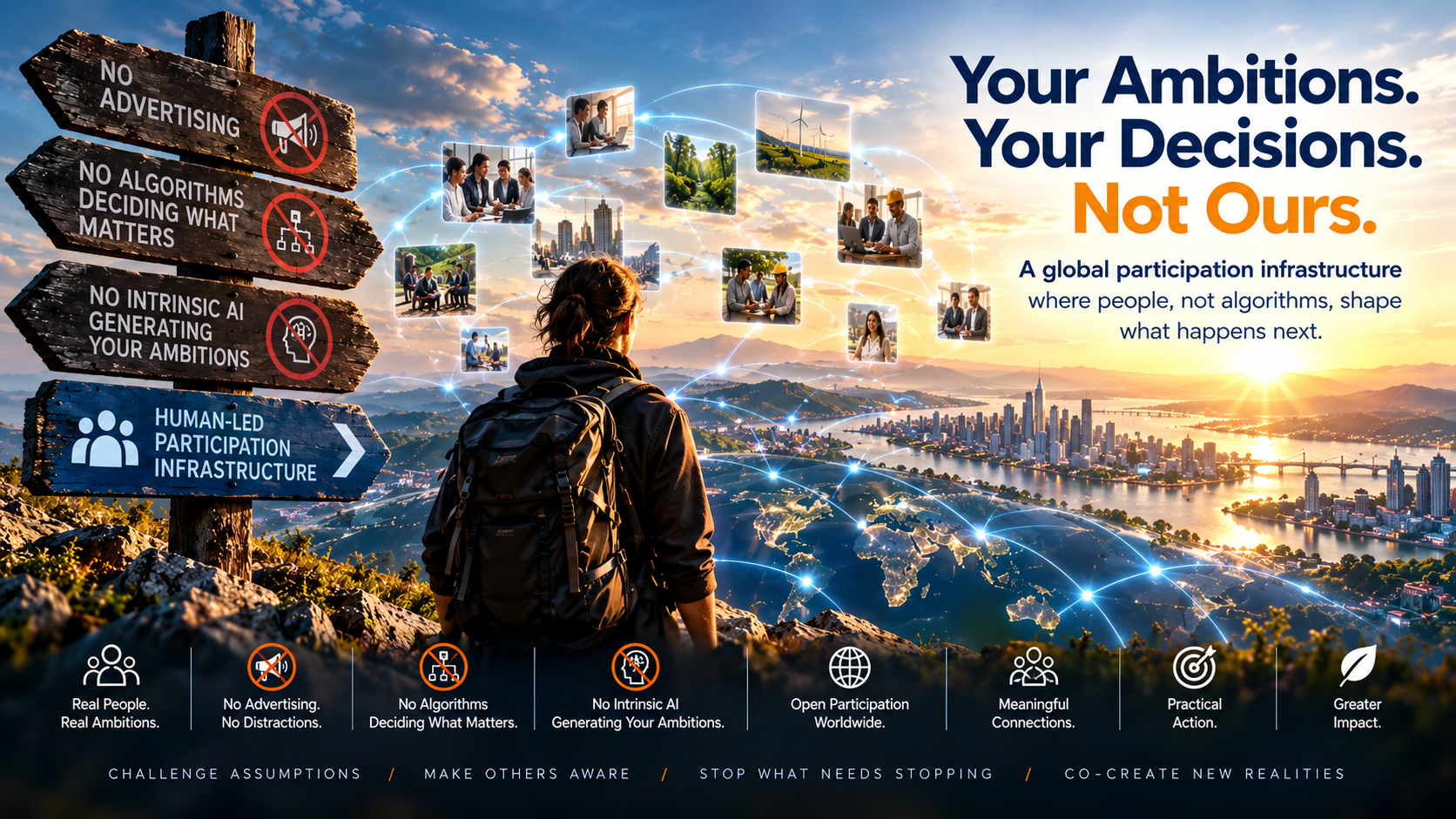
Why Ideas-Shared puts human choice ahead of advertising, engagement algorithms and automated ambition.
Every day, billions of people use digital platforms to communicate, discover information, express opinions, share experiences and connect with others.
These technologies have transformed the way we live and work. They’ve created extraordinary opportunities, brought people closer together and made information accessible on a scale previous generations could scarcely have imagined.
But they’ve also introduced something worth questioning.
Who determines what we see, what receives attention, what influences our decisions and, increasingly, what we think about?
On many platforms, advertising, recommendation algorithms and automated content play a significant role in shaping the experience.
That’s not necessarily surprising. Different platforms have different purposes, business models and commercial priorities.
But when we began developing Ideas-Shared, we were trying to achieve something different.
We weren’t looking to create another environment primarily concerned with attracting attention, generating content or encouraging people to consume more information.
We wanted to help people do something with their ambitions.
To question established assumptions, make others aware, address problems, explore opportunities, bring people together and pursue outcomes that matter to them.
And that led us to some deliberate design decisions.
No integrated advertising. No engagement algorithms deciding which ambitions matter. No intrinsic generative AI manufacturing people’s ideas or ambitions.
Not because these technologies cannot be useful.
But because we believe human choice should remain at the centre of participation.
Your Attention Is Not Our Product
Advertising has financed much of the digital world.
It has enabled platforms to provide services at little or no direct cost to users, helped businesses reach customers and supported countless commercial activities.
Advertising itself isn’t the problem.
But advertising-funded platforms can face an inherent tension between serving users and generating revenue from their attention.
The longer people remain engaged, the more opportunities may exist to display advertisements, collect behavioural information or influence purchasing decisions.
That commercial logic can shape how platforms are designed.
Ideas-Shared takes a different approach.
We don’t sell advertising space within our participation environment.
We don’t need to interrupt someone’s exploration of an ambition with a commercial message.
We don’t need to encourage people to spend additional time scrolling simply to create more advertising opportunities.
And we don’t need to make advertising revenue the organising principle behind the experience.
Our commercial model is built around providing participation infrastructure and membership services.
That creates a different priority.
We want people to find the environment sufficiently useful that they choose to participate.
Not because we’ve engineered an endless stream of distractions.
But because they have something they want to explore, contribute, change, improve, protect, stop, create or achieve.
Your attention belongs to you. What you choose to do with it should be your decision.
Who Decides Which Ambitions Matter?
Algorithms are everywhere.
They help digital systems search, sort, process information and perform countless essential functions.
Ideas-Shared uses software, so naturally it uses algorithms in the ordinary technical sense.
But there’s an important difference between using algorithms to operate a platform and using them to determine what deserves people’s attention.
Many digital services personalise what users encounter based on previous behaviour, predicted interests, popularity or engagement.
These systems can be extremely useful for discovering relevant information.
But they can also narrow what people encounter, reinforce existing preferences or reward content that attracts attention rather than content that deserves careful consideration.
Now imagine applying that approach to human ambition.
Should an ambition concerning a local community receive less opportunity to be discovered because it hasn’t attracted substantial engagement?
Should a complex societal problem be considered less important because it isn’t immediately popular?
Should an individual’s personal ambition compete with sensational content for visibility?
And who should decide whether a particular ambition matters?
The platform?
An algorithm?
An advertiser?
Or the people whose lives, organisations and communities might be affected?
We believe people should decide what matters to them.
That’s why Ideas-Shared isn’t designed around engagement-driven algorithms determining which ambitions deserve priority.
Members can explore the Ambition Directory, discover activities, consider different perspectives and decide for themselves where they want to participate.
They might encounter something familiar.
They might discover something entirely unexpected.
They might agree with an ambition.
They might question it.
They might offer support, suggest an alternative or decide to pursue something completely different.
The important thing is that these choices belong to the participants.
An ambition doesn’t have to be popular to matter. And popularity doesn’t automatically make an ambition worthwhile.
Artificial Intelligence Can Help. But Whose Ambition Is It?
Artificial intelligence is already changing how people research, write, analyse information, solve problems and develop ideas.
Used thoughtfully, it can be an extraordinarily useful tool.
It can help someone articulate a complicated thought, explore alternatives, challenge assumptions, develop a proposal or communicate an ambition more effectively.
We use AI ourselves to support the development of Ideas-Shared content.
And there’s no contradiction in that.
The distinction is between people choosing to use AI as a tool and a participation platform using AI to originate or direct people’s ambitions on their behalf.
Ideas-Shared does not include intrinsic generative AI designed to manufacture members’ thoughts, ideas or ambitions.
We haven’t attempted to automate the human motivation at the heart of the platform.
Because the starting point matters.
An ambition might emerge from someone’s experience.
From a frustration.
From an opportunity they’ve identified.
From something they’ve witnessed, questioned or imagined.
It might reflect years of professional knowledge, a deeply personal aspiration or concern about circumstances affecting an entire community.
That human origin gives the ambition its purpose.
AI might help someone develop their thinking, examine evidence, identify weaknesses or communicate more clearly.
But it shouldn’t be necessary for the platform to tell people what they ought to want.
AI can support the thinking. People must retain ownership of their ambitions and decisions.
And when AI is used, its outputs should still be questioned, verified where necessary and subjected to human judgement.
After all, challenging assumptions includes challenging those generated by technology.
A Different Relationship Between People and Technology
These three design choices reflect something much more fundamental.
Ideas-Shared was engineered to serve human participation, rather than making human participation serve the platform.
Consider the difference.
On a conventional content-driven platform, success may be associated with attracting attention, increasing engagement or expanding the volume of material consumed.
On Ideas-Shared, the purpose is to enable people to pursue ambitions.
A member shares a listing because they want others to discover an opportunity.
They invite someone because that person might be interested, benefit or contribute.
They create a group because people have a reason to come together.
They undertake a course because they want to develop knowledge or capability.
They plan and execute tasks because there is something they want to accomplish.
These actions aren’t intended to manufacture engagement for its own sake.
They are part of a journey towards something the participants themselves consider worthwhile.
And because the actions are familiar, independent and repeatable, people can undertake them whenever and however they choose.
Someone might share the same listing repeatedly because the ambition remains relevant.
Someone else might contribute to several different activities.
Another member might participate occasionally, when something captures their interest.
There is no requirement to turn every action into a competition, score or artificial measure of personal significance.
The value lies in the journey, the opportunities created and what participants ultimately accomplish.
Human Ambition Doesn’t Need to Be Manufactured
Think about the sheer quantity of ambition already present in the world.
Billions of individuals.
Millions of organisations.
Families, communities, businesses, charities, campaigners, innovators, educators, researchers, public institutions and informal groups.
All with things they want to change, improve, protect, stop, create or achieve.
Some ambitions are personal.
Others are professional.
Some concern the conditions affecting entire societies.
And many remain disconnected from the people, knowledge, capabilities and resources that could help progress them.
The world doesn’t lack ambition. It lacks sufficient opportunities to bring that ambition together and act upon it effectively.
That’s the opportunity Ideas-Shared was created to address.
Not by deciding what people should pursue.
Not by generating ambitions for them.
And not by determining which ambitions deserve attention based on commercial or engagement priorities.
But by creating an environment where people can make ambitions visible, discover one another, combine capabilities and organise practical activities.
The ambitions belong to the people.
The decisions belong to the people.
And the outcomes depend on what those people choose to do.
Freedom to Participate Also Means Freedom to Disagree
There’s another important consequence of putting human choice at the centre of the design.
People won’t always agree.
They will have different experiences, beliefs, priorities, interpretations and ambitions.
Someone may identify a problem that another person doesn’t believe exists.
Someone may propose a solution that others consider inappropriate.
An ambition may challenge established practices, institutions or assumptions.
And an activity may develop in unexpected directions as participants contribute new information or perspectives.
That’s part of human participation.
The objective isn’t to manufacture agreement. It’s to create opportunities for people to examine what matters and pursue worthwhile outcomes.
That requires a willingness to challenge assumptions, including our own.
It requires distinguishing evidence from opinion.
It requires considering alternatives.
And it requires recognising that no individual, organisation or technology possesses all the answers.
Of course, freedom to participate doesn’t mean freedom from reasonable rules, legal obligations or responsibilities towards others.
But within those boundaries, people should have meaningful opportunities to decide what they want to explore and how they wish to contribute.
We don’t need everyone to think alike. We need better opportunities for people to think, question and act together.
The Technology Should Enable the Possibilities, Not Define Them
Ideas-Shared has been deliberately constructed around familiar human activities.
People identify ambitions.
They share information.
They ask questions.
They invite others.
They create groups.
They combine knowledge and experience.
They plan activities, undertake tasks and work towards outcomes.
Our seven-step approach provides a recognisable structure for progressing ambitions.
The independent and repeatable micro-actions enable participation throughout that journey and beyond it.
Together, they support what we describe as Optimised Ambition Realisation.
Not because we’ve invented human ambition or collaboration.
But because we’ve brought familiar activities together into a coherent environment designed to make pursuing ambitions more accessible and repeatable.
And here’s something particularly important.
The sophistication should be in the thinking and construction, not in the demands placed upon the participant.
People shouldn’t need to understand the engineering behind Ideas-Shared before they can benefit from it.
They should be able to join, explore, discover something relevant, contribute and continue.
Sometimes that might involve a few minutes.
Sometimes it might lead to years of collaboration.
Sometimes an ambition might concern one person’s circumstances.
Sometimes it might have implications for millions.
The underlying approach remains available.
What changes is what people choose to do with it.
Imagine What Becomes Possible When People Make the Choices
Now imagine thousands of people exploring ambitions without an advertising system competing for their attention.
Imagine people discovering activities without an engagement algorithm deciding which ambitions deserve prominence.
Imagine individuals, informal groups and organisations originating their own ideas, questions and ambitions, while freely choosing which external technologies and resources might help them.
Some will discover opportunities that improve their personal circumstances.
Others will find ambitions relevant to their organisations, professions or communities.
Some will identify activities capable of addressing wider societal challenges.
And some will encounter possibilities they had never previously considered.
They might participate briefly.
They might make a substantial contribution.
They might initiate something entirely new.
And they might discover that an ambition created by someone they’ve never met could materially improve their own life — or the lives of thousands or millions of others.
None of this guarantees success.
Realising ambitions requires effort, judgement, capability, resources and, often, sustained collaboration.
But the opportunity to discover and pursue those ambitions shouldn’t depend on whether they generate advertising revenue, attract algorithmic attention or conform to an automated prediction of what people ought to want.
Human ambition deserves room to be human.
Your Ambitions. Your Decisions. Not Ours.
Ultimately, our design decisions come down to a simple principle.
We don’t want to determine your ambitions.
We don’t want to manufacture your ideas.
We don’t want to sell advertising against your attention.
And we don’t want engagement algorithms deciding what should matter to you.
We want to provide an environment in which you can decide what matters, discover possibilities, connect with others and pursue outcomes.
You can use AI to help develop your thinking.
You can use social media to share your listings.
You can use whatever appropriate tools, knowledge, relationships and resources help you progress.
But the ambition remains yours.
The decision to participate remains yours.
And the opportunity to work with others remains open.
We created Ideas-Shared not merely to help people navigate the world as it is, but to give them the opportunity to change what isn’t working and create what doesn’t yet exist.
That’s why human choice matters so much.
Because nobody, including us, can know everything people might eventually achieve when they begin bringing their ambitions, capabilities and efforts together.
The Future Shouldn’t Be Determined by What Keeps Us Watching.
It should be influenced by what we choose to question, explore, improve, protect, create and achieve.
Your ambitions. Your decisions. Not ours.
Explore the Ideas-Shared Global Hub, discover the ambitions already being shared and consider what you might want to do.
Challenge Assumptions. Make Others Aware. Stop What Needs Stopping. Co-Create New Realities.
Be part of it.