
Technology Is Advancing. But Who Is Deciding Where We Go?
We are entering an extraordinary period in human history.
Artificial intelligence is transforming how we think, analyse, create and solve problems. Automation is changing how we work, produce, distribute and deliver. Robotics, advanced computing and connected technologies are extending capabilities that would have seemed impossible just a generation ago.
The potential is enormous.
We can process more information, make faster decisions, eliminate repetitive work, accelerate scientific discovery and achieve levels of productivity previously unimaginable.
Yet there is a fundamental question that deserves far more attention.
Who is deciding what all this extraordinary capability should be used to achieve?
Technology can make us more capable. It cannot, by itself, establish what constitutes a better world.
That requires something distinctly human.
It requires ambition, judgement, imagination, values, responsibility and the freedom to decide what matters.
Above all, it requires sovereign human participation.
Human Sovereignty Is Not an Outdated Concept
Every person has the capacity to recognise something that matters to them.
It might be a personal ambition, an opportunity at work, a problem in their community, an injustice they want addressed, an environmental concern or an idea for an entirely different way of doing things.
They may want to improve something, create something, protect something, challenge an assumption or stop something that should no longer be happening.
This capacity to determine what matters and initiate action is a fundamental expression of human sovereignty.
It does not require permission from an institution, political party, employer, technology company or established authority to have an ambition.
Nor does it require everyone to share the same ambition.
People can hold different perspectives, pursue different outcomes and still find common ground where their interests align.
Personal sovereignty becomes collective capability when people are free to combine their ambitions, knowledge, resources and efforts with others.
That is where participation becomes so important.
Not participation as a token consultation exercise, a survey, a social media reaction or an invitation to comment on decisions already made.
Participation as the practical ability to initiate, organise, contribute and deliver outcomes.
AI Can Expand Capability. Humans Must Shape Purpose.

Consider what artificial intelligence makes possible.
An individual can now access analytical capabilities that once required specialist teams. A small business can explore opportunities previously available only to large corporations. Communities can investigate complex problems, develop proposals and organise information at unprecedented speed.
AI can help people understand their circumstances, challenge assumptions, evaluate alternatives and discover possibilities they may never have considered.
Automation can then help translate decisions into efficient, repeatable activity.
But there is a crucial distinction between capability and purpose.
AI can help us explore how to build a city. It cannot independently establish what kind of city its inhabitants want to live in.
It can optimise a business process. It cannot determine whether the process should exist in its current form.
It can model economic growth. It cannot settle whose prosperity matters, what should be protected or which trade-offs society should accept.
It can recommend solutions to environmental challenges. It cannot replace the human decisions, commitments and collective action required to implement them.
These are questions of ambition, values, legitimacy and human agency.
And they become more important, not less, as technology grows more powerful.
The Missing Ingredient Is Organised Participation
We have spent decades developing increasingly sophisticated systems for managing information, transactions, communication and productivity.
We have built global networks, digital marketplaces, social platforms, enterprise software, artificial intelligence and automated workflows.
Yet we have invested comparatively little in the infrastructure needed to help people determine what they want to achieve together and organise themselves to make it happen.
The consequences are visible throughout society.
People have ideas but cannot find the right collaborators.
Businesses have challenges but cannot readily mobilise the collective intelligence of their employees, customers and suppliers.
Communities recognise problems but struggle to organise the resources needed to address them.
Institutions consult people without necessarily creating practical routes for them to participate in delivery.
Societies debate their future without establishing sufficiently clear, shared ambitions or mechanisms through which willing participants can pursue them.
We have become extraordinarily good at connecting information.
We are still learning how to connect human ambition to organised action at scale.
That is a very different challenge.
And it is one that technology alone cannot resolve.
Three Forces That Could Transform Our Future
Imagine an operating environment in which three complementary forces work together.
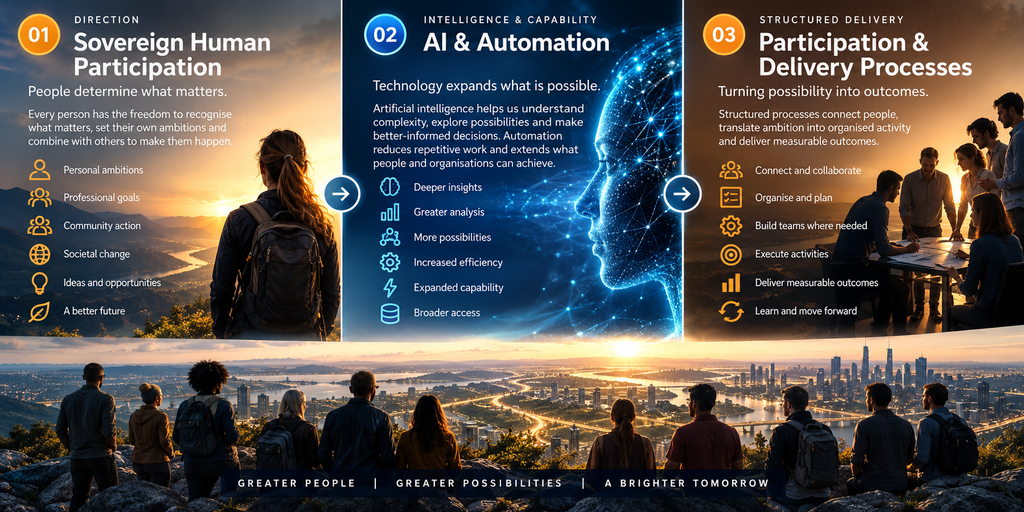
These forces are not interchangeable.
Human participation provides direction and legitimacy. Artificial intelligence expands understanding and capability. Automation increases the capacity to execute.
Together, they offer something far more consequential than productivity improvement alone.
They create the possibility of a world in which far more people can shape and deliver the outcomes that matter to them.
But only if human participation is treated as a primary component of the system, rather than an afterthought.
What Happens When Participation Is Missing?
Imagine a future in which AI and automation continue advancing rapidly, but the structures through which people participate remain largely unchanged.
Technology becomes more capable. Organisations become more efficient. Decisions are made faster. Outputs increase.
But the same relatively small number of people and institutions may continue determining which ambitions receive attention, which problems are prioritised and which opportunities are pursued.
We risk accelerating existing systems without sufficiently questioning whether they are producing the outcomes people actually want.
More efficient bureaucracy is still bureaucracy.
More productive economic activity does not automatically mean broader prosperity.
Faster political communication does not necessarily produce better collective decisions.
Greater technological capability does not guarantee greater human agency.
The question is not simply whether we can do more.
It is whether more people can meaningfully influence what gets done, why it gets done and who benefits.
This is why sovereign human participation deserves a place alongside AI and automation in any serious discussion about the future.
It is not an optional social benefit of technological progress.
It is one of the conditions through which technological progress can become meaningful human progress.
From Passive Populations to Active Participants
For much of modern history, participation has been organised around established roles.
People participate in the economy primarily as workers, consumers, business owners or investors.
They participate in politics primarily as voters, party members, campaigners or elected representatives.
They participate in organisations through prescribed responsibilities, management structures and approved processes.
They participate in communities through voluntary groups, associations and local initiatives.
All these arrangements have value.
But human ambition does not fit neatly within institutional boundaries.
A person may simultaneously want to improve their health, help a neighbour, develop a business, protect a local environment, challenge a national policy and contribute to a global scientific breakthrough.
Why should their ability to act be constrained by the particular institution, geography or organisational structure through which they happen to be participating?
Why should an ambition have to wait until an established authority decides it deserves attention?
And why should people with complementary ambitions struggle to discover one another simply because they operate in different sectors, organisations or countries?
The next great advance may not be another technology that connects people.
It may be the infrastructure that enables people to exercise their sovereign power together.
The Value of Participation Multiplies at Scale

Consider a single person with an ambition.
They may possess the idea, motivation and knowledge to initiate something meaningful, but lack the resources or capabilities to deliver it.
Now imagine that person can discover others who share their ambition, understand the challenge, possess complementary skills or are simply willing to help.
The ambition becomes more achievable.
Add artificial intelligence to help the participants investigate, design, plan and evaluate their options.
Add automation to reduce administration, coordinate repetitive activities and improve delivery efficiency.
Now extend that capability across communities, businesses, public bodies and countries.
The possibilities multiply.
Not because everyone must agree on everything.
Not because a central authority decides what everyone should pursue.
But because people can organise voluntarily around the ambitions that matter to them.
One person might contribute knowledge. Another might offer a resource. Another might challenge an assumption. Another might bring an existing solution. Others might provide funding, practical assistance, professional expertise or access to a wider network.
Some will initiate. Some will lead. Some will contribute occasionally. Others will simply make themselves available when an opportunity aligns with their interests.
Participation need not be uniform to be valuable.
Indeed, the diversity of human ambitions and capabilities is one of its greatest strengths.
At scale, this creates the potential for an extraordinary expansion in collective problem-solving and value creation.
This Is Where Ideas-Shared Comes In
Ideas-Shared has been developed around a simple but far-reaching proposition.
Every person has sovereign power to decide what matters. When we combine that power intelligently with others, personal, professional and societal ambition becomes collective capability.
Our purpose is to coordinate voluntary participation to improve conditions that matter.
We are building participation infrastructure through which individuals, informal groups and organisations can pursue ambitions, initiate activities, discover others, organise contributions and deliver measurable outcomes.
It is an ambition-led approach rather than one confined to a particular institution, profession, cause or sector.
A person can start with an idea, a problem, a question, an opportunity, an announcement, a discussion or a declared ambition.
Others can discover it, respond, contribute and participate according to their interests and capabilities.
Where more structured delivery is required, participants can organise teams, establish tasks, coordinate activity and record outcomes.
The same underlying operating model can support something as simple as finding an answer to a question or as ambitious as addressing a major societal challenge.
Artificial intelligence can strengthen that model by helping participants understand problems, explore options, identify relevant knowledge and develop practical approaches.
Automation can strengthen it by reducing the effort required to coordinate and deliver activity.
But neither replaces the people whose ambitions give the activity its purpose.
The human remains sovereign.
The technology serves the ambition.
And participation turns possibility into collective capability.
The Future Is Not Simply Artificial Intelligence
We hear a great deal about the AI economy, the automation economy and the future of work.
These are important conversations.
But perhaps we should also be discussing the future of participation.
What becomes possible when billions of people have better ways to express their ambitions, discover shared interests, combine capabilities and pursue outcomes?
What happens when organisations can mobilise intelligence and initiative beyond their conventional boundaries?
What changes when communities can move more readily from recognising problems to organising solutions?
And what kind of economy might emerge when value creation is no longer understood primarily through established organisational structures, but also through the ambitions and contributions of people working together?
These questions point towards something much larger than a technological revolution.
They point towards the possibility of a participation revolution.
One in which AI expands intelligence, automation expands execution and sovereign human participation determines direction.
One in which people are not merely adapting to a future being created around them.
They are actively involved in creating it.
The Most Important Question of the AI Age
The question is not whether artificial intelligence will become more powerful.
It will.
Nor is it whether automation will transform how things get done.
It already is.
The question is whether we will develop the human participation infrastructure needed to make full and responsible use of these extraordinary capabilities.
Because the greatest opportunity is not simply to build more intelligent machines or more efficient systems.
It is to enable more people to exercise their intelligence, imagination, ambition and sovereign power in pursuit of the future they want.
AI can expand what is possible. Automation can expand what we can deliver. Sovereign human participation determines what is worth pursuing.
And when all three work together, the potential for human progress becomes extraordinary.