What might you be capable of? What have you always wanted to achieve? And what legacy could you leave if you discovered that the possibilities were far greater than you ever imagined?
There is something extraordinary about human ambition.
Every day, people imagine things they would like to change, improve, stop, protect, create or achieve. Some ambitions are deeply personal. Others concern our families, communities, professions, businesses, countries or the world around us.
Some are modest. Some are enormous. Some seem entirely achievable. Others appear so far beyond our circumstances that we dismiss them almost as quickly as they enter our minds.
We tell ourselves we don’t have the time, money, knowledge, connections or resources. We assume that someone else must be better placed to act. We imagine that meaningful change requires an organisation, an institution, a substantial budget or a team of specialists.
And sometimes, we simply accept that what we would really like to achieve is beyond our reach.
But what if we’re measuring our possibilities against the wrong thing?
What if the question isn’t what we can achieve alone, but what we might initiate, contribute to or make possible with others?
What if our greatest limitation isn’t the size of our ambitions, but the assumption that we must possess everything necessary to achieve them ourselves?
It Only Takes One Person to Begin
Ideas-Shared began with an ambition.
Not a substantial investment. Not a large team. Not a government programme or an established institution. Not an organisation with hundreds of employees and a department dedicated to innovation.
An ambition.
A belief that people should have a better way to make their ambitions visible, discover one another, combine capabilities and actively pursue the things that matter to them.
That ambition began in December 2018.
What followed was years of thinking, questioning, designing, learning, experimenting, building, revising and occasionally starting again. All while maintaining a professional career and finding the time and resources to keep moving forward.
Today, that original ambition has developed into an interconnected ecosystem of websites, a Global Hub, Private Hubs, a participation methodology, activity playbooks, delivery processes, membership structures, educational resources, thought leadership and a growing body of content.
An infrastructure designed to help individuals, informal groups and organisations pursue personal, professional and societal ambitions.
And much of it has been conceived, developed and brought together by one person.
There have been technologies, tools, services and contributions from others along the way. No one creates something of this nature entirely in isolation. But the direction, ambition, persistence and responsibility for bringing the pieces together have largely rested with one individual.
It is not presented as a claim of extraordinary personal achievement.
It is presented because it raises a far more interesting question.
If one person can initiate and develop something of this scope, what might become possible when ten, a hundred, a thousand or a million people begin combining their ambitions and capabilities?
The World Has Changed What One Person Can Do
Consider the tools now available to an individual.
We can publish globally without owning a media company. We can develop software without employing an entire technology department. We can access knowledge that once required years of specialist research. We can communicate across continents, create sophisticated visual experiences, organise information, develop business propositions and reach people we could never previously have encountered.
Artificial intelligence is extending these possibilities further, helping individuals undertake activities that might once have required substantial teams, specialist expertise or considerable financial resources.
This doesn’t mean that technology replaces human knowledge, judgement, experience or relationships. Nor does it mean that every ambition suddenly becomes achievable.
But it changes the starting point.
An individual with a clear ambition, the willingness to learn and access to appropriate tools can now initiate activities that would have been extraordinarily difficult only a few years ago.
The distance between imagining something and beginning to create it is shrinking.
And that raises a remarkable possibility.
If technology can extend what one person can do, what happens when it also helps people discover and combine what they can do together?
Perhaps we are only beginning to understand the implications.
One Person Has Limits. Collective Capability Opens Possibilities.
No matter how capable, knowledgeable or determined we become, there will always be limits to what we can achieve alone.
We cannot possess every skill, understand every subject, know every person, access every resource or anticipate every possibility.
But we don’t necessarily need to.
Somewhere, someone may already possess the knowledge we lack. Someone may have encountered the problem we are trying to solve. Someone may have developed a solution, discovered an opportunity or established a relationship that could make an enormous difference.
Someone may share our ambition but have no idea that we exist.
And we may possess something equally valuable to them.
The difficulty is that these capabilities are distributed across billions of people, millions of organisations and countless disconnected networks.
We often have no practical way of discovering one another.
We don’t know what other people want to achieve. We don’t know who agrees, who has relevant knowledge, who might contribute, what resources exist or which opportunities could emerge if different capabilities were brought together.
And so ambitions remain isolated.
Ideas remain unexplored.
Problems remain unresolved.
Opportunities remain undiscovered.
Not necessarily because the capabilities are missing, but because the people who possess them have never found one another.
What if the greatest untapped resource in the world is not something we need to invent, but the capability that already exists and has yet to be connected?
Imagine What Ten People Could Do
Now consider an individual with an ambition that seems beyond their immediate capabilities.
Perhaps they want to improve something in their community, create a business, develop a new product, challenge an outdated practice or solve a problem affecting people they care about.
They begin alone.
Then someone with relevant experience joins them. Another contributes a different perspective. Someone knows a potential partner. Someone has access to a resource. Someone challenges an assumption that has been limiting the entire approach.
Suddenly, the ambition looks different.
The original idea may evolve. New possibilities emerge. Activities can be shared. Problems can be approached from different directions.
Ten people do not simply represent ten times the available effort.
They may bring ten different networks, ten different sets of experiences, ten different combinations of knowledge and relationships, and countless opportunities that none of them could have discovered independently.
And perhaps only three of them need to work directly on the ambition. The others may contribute something valuable at a particular moment and then continue pursuing their own priorities.
Participation need not mean permanent commitment to everything.
It can mean contributing what we can, where it matters, when it is useful.
Now imagine what happens when those possibilities extend beyond ten people.
What About a Hundred? A Thousand? A Million?
A hundred people could pursue multiple ambitions, form different teams, share capabilities and connect activities that might otherwise remain entirely separate.
A thousand could introduce knowledge, experience and relationships across professions, communities, industries and geographical boundaries.
Ten thousand could create opportunities for countless independent activities to progress simultaneously, with people contributing according to their own interests and capabilities.
A hundred thousand could connect ambitions and resources across organisations, communities and countries that might never otherwise interact.
And a million?
A million people would not need to agree on one ambition, belong to one organisation or follow one centrally directed programme.
They could pursue thousands of different ambitions, individually and collectively, discovering where their interests intersect and voluntarily combining their capabilities.
Some activities might involve two people. Others might involve hundreds, thousands or many more.
Some might take an afternoon. Others might take years.
Some might improve one person’s circumstances. Others might influence entire industries, communities or societies.
And some might produce outcomes nobody originally imagined.
The significance of scale is not simply that more people become available to do more work. It is that more ambitions, capabilities, relationships and opportunities become discoverable.
New combinations become possible.
New activities can begin.
And one outcome can create the conditions for another.
The possibilities expand not simply because there are more people, but because there are more ways for people to contribute to one another’s ambitions.
You Don’t Have to Change the Whole World to Change Someone’s World
When we talk about ambition and legacy, it is easy to imagine extraordinary achievements, famous names, global organisations and world-changing inventions.
But legacy need not be measured by fame, wealth, scale or public recognition.
Perhaps you help someone overcome a difficulty that has affected them for years. Perhaps you share knowledge that enables someone to pursue a career they had never considered possible. Perhaps you create something that improves your community, protects an important resource or gives others an opportunity they would not otherwise have had.
Perhaps you start a business that provides livelihoods for families. Perhaps you challenge a practice that has gone unquestioned for decades. Perhaps you help develop a solution that another person takes much further than you ever could.
Or perhaps you introduce two people who go on to achieve something extraordinary together.
You may never know the full consequences of that introduction.
You may never know how many people benefited from something you helped initiate.
You may never see the final outcome of an ambition that continues long after your own involvement has ended.
But that does not diminish the significance of your contribution.
You don’t need to change the whole world to leave a legacy. You might change one person’s world, and that person might go on to change the lives of countless others.
What Have You Always Wanted to Do?
This is where the question becomes personal.
Not what should society achieve. Not what should organisations do. Not what should governments change or what should someone else take responsibility for.
What about you?
What have you always wanted to do?
What have you dismissed as unrealistic because you didn’t have the money, time, knowledge or connections?
What problem have you encountered repeatedly and wished someone would solve?
What opportunity have you recognised but never pursued?
What would you like to create, improve, protect or change?
What have you learned through your life that could be valuable to somebody else?
What relationships, capabilities or resources do you possess that might make another person’s ambition achievable?
And what might you discover if you made your own ambitions visible?
Perhaps someone else has been thinking about exactly the same thing.
Perhaps the solution already exists somewhere.
Perhaps you have been waiting for the wrong resources, approaching the problem from the wrong direction or assuming that something requires far more than it actually does.
Perhaps the first step is much smaller than you imagined.
Or perhaps the ambition really is enormous, but that doesn’t mean you have to achieve it alone.
What if the thing you’ve always wanted to do is waiting for you to discover the people who could help make it possible?
We Have Spent Too Long Measuring People by What They Can Achieve Alone
Much of our thinking about success is organised around individuals and organisations.
We celebrate personal achievement, organisational performance, leadership, innovation and the ability to overcome obstacles.
These things matter.
But they can also reinforce the assumption that capability belongs primarily to individuals or established institutions.
We ask whether someone has the necessary qualifications, resources, experience, authority or financial backing.
We ask whether an organisation has the budget, people and capacity to deliver.
We assess ambitions against the capabilities already available within existing boundaries.
And when those capabilities appear insufficient, the ambition may never begin.
But what if the boundary is the problem?
What if the knowledge exists outside the organisation? What if the necessary capability belongs to someone in another country? What if a community has resources that a business lacks, or a business has capabilities that could help a community?
What if the person with the ambition doesn’t need to own or control everything necessary to achieve it?
What if they simply need a way to discover, connect and voluntarily combine the capabilities that matter?
This does not eliminate the need for organisation, accountability, resources or effective delivery.
It changes how we might bring them together.
Instead of beginning with the limitations of what we already possess, we can begin with the ambition and discover what might become possible.
The Legacy of Participation
There is another dimension to all of this that deserves consideration.
What if the most valuable thing we leave behind is not simply something we have personally created, but the opportunities we have made possible for others?
An organisation can outlive its founder. An idea can evolve beyond its original purpose. A relationship can lead to achievements nobody anticipated. A method can be adopted, improved and applied in circumstances its originator never imagined.
And an ambition can become the starting point for many others.
This is particularly interesting when we consider participation at scale.
One person’s ambition may inspire another. One activity may reveal an opportunity. One outcome may establish knowledge or capabilities that others can use. One connection may create a new relationship between communities, organisations or individuals.
The benefits need not remain confined to those who initiated the activity.
They can spread, evolve and create further possibilities.
Not every activity will succeed. Not every ambition will attract support. Not every contribution will produce the intended outcome.
But even unsuccessful activities can generate knowledge, relationships and experience that become valuable elsewhere.
And the more people are able to participate, the greater the opportunity to discover what works, what doesn’t and what might be possible next.
Perhaps the most enduring legacy is not simply what we achieve, but what our participation enables others to achieve after us.
Imagine a World Where More People Could Begin
Now imagine a world in which people no longer needed to wait until they possessed everything necessary to pursue an ambition.
Where an individual could make an ambition visible and discover people who might help.
Where a community could identify what matters to its members and mobilise the capabilities already surrounding it.
Where a business could connect employees, customers, suppliers and partners around opportunities that might otherwise remain hidden.
Where knowledge could cross professional, organisational and geographical boundaries.
Where people could participate without surrendering their independence or being required to agree about everything.
Where ambitions could begin at any scale, develop through voluntary participation and progress towards measurable outcomes.
And where the results of one activity could create opportunities for others.
This is the possibility behind Ideas-Shared.
An ambition-led, polycentric participation network designed to help people decide what matters, initiate activities, discover one another, combine capabilities and pursue outcomes.
Not a centrally directed programme in which everyone must follow the same priorities.
Not another environment in which people simply observe, react and move on.
But a way for individuals, informal groups and organisations to exercise their own agency while discovering what becomes possible through participation.
Personal sovereignty becoming collective capability.
What Legacy Could You Leave?
There is something both exciting and humbling about the possibilities.
None of us knows the full extent of what we might achieve in our lifetime. We cannot know every person we might meet, every opportunity we might discover or every consequence of the activities we initiate.
We cannot know which small contribution might become important to someone else, which idea might develop into something extraordinary or which ambition might continue long after our own involvement has ended.
And perhaps that is precisely why we should begin.
Not because success is guaranteed.
Not because every ambition will change the world.
Not because we must all become entrepreneurs, innovators, campaigners or leaders.
But because every person has something that matters to them, and every person has some capacity to contribute.
The ambition may be personal. It may be professional. It may be societal.
It may require one person to help, or it may eventually involve millions.
The scale is not what gives it significance.
What matters is that we have the opportunity to decide what is worth pursuing and discover what might become possible.
And perhaps the most remarkable thing about the future is that nobody knows what people will ultimately create when more of us have the means to participate.
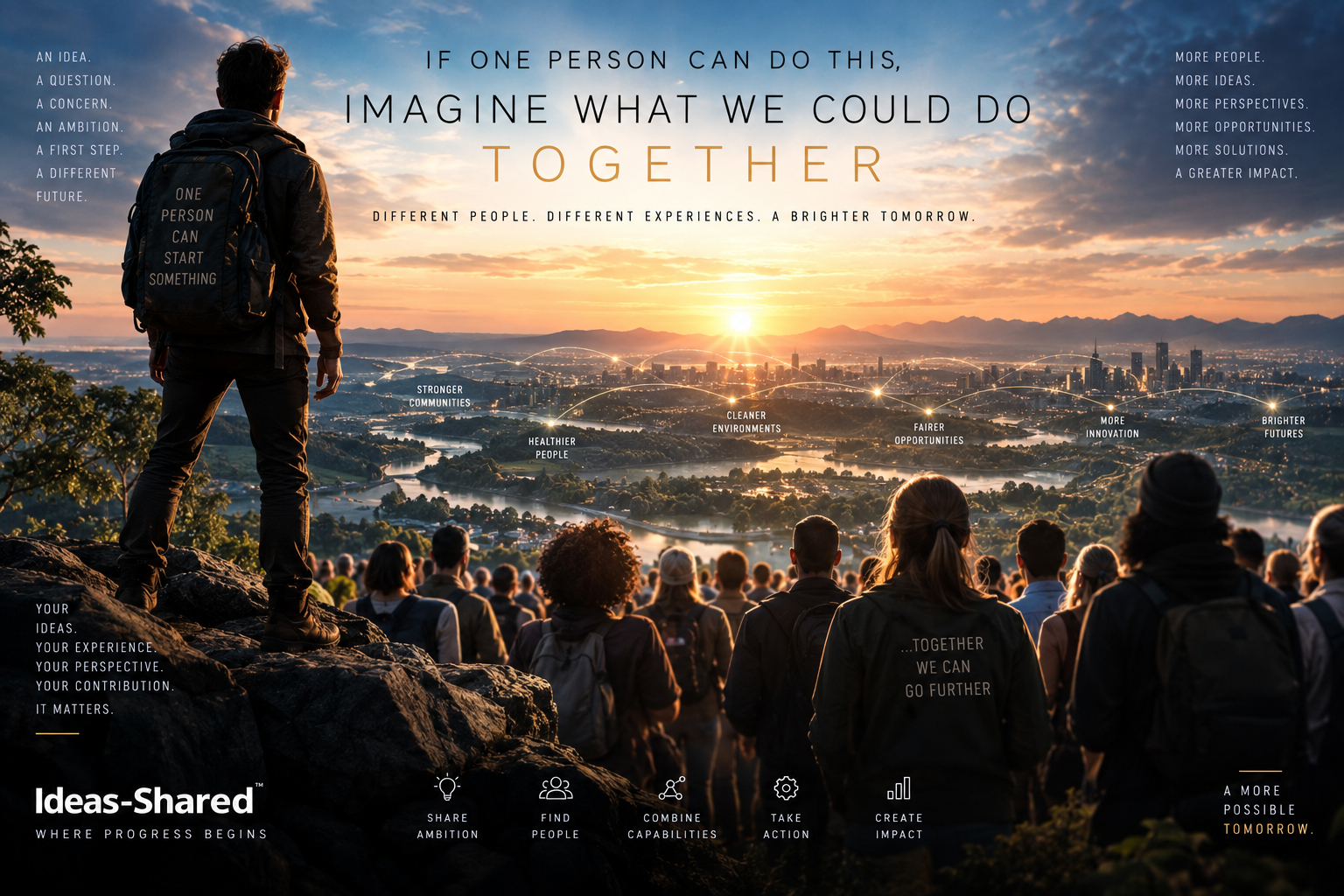
If One Person Can Do This…
Ideas-Shared began with one person’s ambition.
The technology, methodology, infrastructure and opportunities now taking shape are intended to help others pursue theirs.
But the ultimate possibilities do not belong to its founder, its technology or the organisation behind it.
They belong to the people who choose to participate.
To the person who decides that something needs to change.
To the person who has an idea but doesn’t know where to begin.
To the person who possesses knowledge that somebody else desperately needs.
To the person who has spent years believing that an ambition is beyond their reach.
To the people who discover one another and realise that something previously unimaginable might actually be possible.
And to those who initiate something whose ultimate significance they may never fully know.
One person can start something. Ten can develop it. A hundred can expand it. A thousand can take it somewhere nobody originally imagined.
And a million?
Perhaps the most extraordinary thing about a million people is not what they could achieve together, but how many different futures they could begin creating.
What could you do?
What could we actively do together?
And what legacy might we leave?
You may never know the full extent of what you could make possible for others.
But you’ll never find out if you don’t begin.