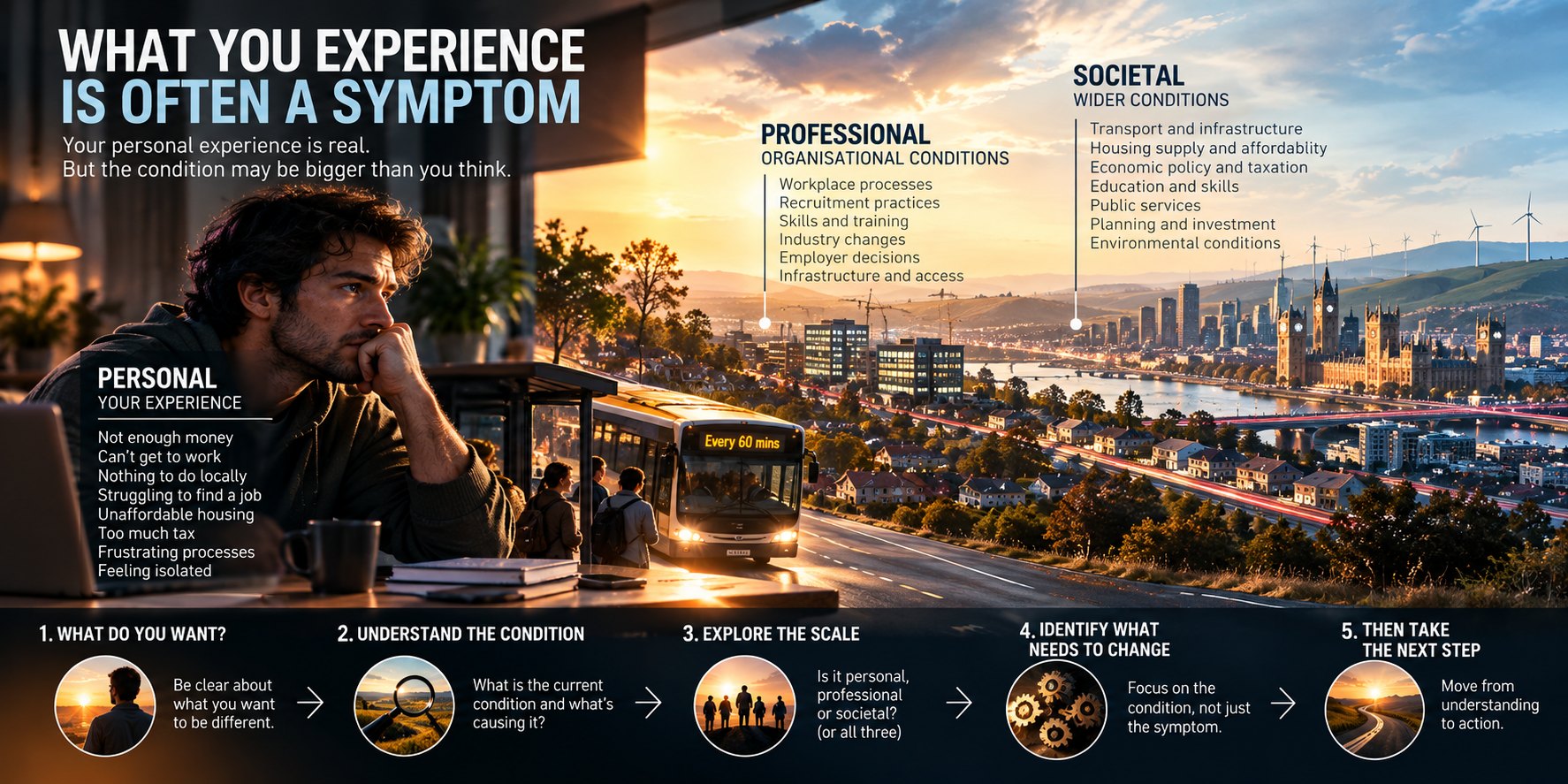
Something isn’t working.
Perhaps you don’t earn enough.
Perhaps you’re struggling to find a decent job.
Perhaps getting around where you live is difficult.
Perhaps something at work wastes hours of everybody’s time.
Perhaps housing is unaffordable.
Perhaps your local high street is dying.
Perhaps a public service you depend upon isn’t delivering what you need.
Perhaps you’re simply bored because there seems to be nothing to do.
Our instinct is often to jump immediately to the next question:
What can I do about it?
But there may be a better question to ask first.
What actually needs to change?
Those questions sound similar.
They aren’t.
And understanding the difference can completely change what we do next.
We Experience the World Personally
Everything ultimately reaches us through our own lives.
A bus service isn’t an abstract transport issue when you’re standing at a bus stop for an hour.
Housing affordability isn’t an economic statistic when you can’t afford somewhere to live.
Productivity isn’t a management concept when a ridiculous process wastes two hours of your working day.
Taxation isn’t simply public policy when you look at your payslip.
The cost of living isn’t an index when you’re deciding what you can afford at the supermarket.
A lack of local amenities isn’t a planning issue when you’re sitting at home thinking:
There’s nothing to do here.
Our experience is personal.
But the condition creating that experience may not be.
That distinction matters.
Start With What You Want
Suppose you say:
I want more money.
There is nothing wrong with that.
It is clear, understandable and entirely legitimate.
But what actually needs to change?
Perhaps you need a better-paid job.
Perhaps you need additional skills.
Perhaps your employer pays below the market rate.
Perhaps your industry has changed.
Perhaps housing consumes too much of your income.
Perhaps childcare costs make additional work uneconomic.
Perhaps transport prevents you reaching better opportunities.
Perhaps taxation concerns you.
Perhaps several of these conditions operate simultaneously.
The ambition remains personal:
I want more money.
But understanding what needs to change requires us to look beyond the ambition itself.
That is where things become interesting.
Personal Doesn’t Mean Isolated
We sometimes talk about things as personal, professional or societal.
It is easy to imagine these as separate compartments.
They aren’t.
They are better understood as measures of scale.
A condition may exist entirely at a personal scale.
You want to learn to play the guitar.
Nothing necessarily needs changing in society.
You probably need a guitar, some instruction, practice and persistence.
You want to write a novel.
Again, the principal conditions may be yours to create.
Time.
Knowledge.
Discipline.
Perhaps some help.
There is no need to manufacture a wider problem where none exists.
But consider something else.
I can’t get to work reliably because the buses only run once an hour.
The effect is personal.
The condition isn’t necessarily personal at all.
Changing your attitude won’t make the bus arrive.
You might find a temporary personal workaround — buy a car, cycle, get a lift, take a taxi or find another job.
But the underlying transport condition remains.
And everyone else depending upon that service continues experiencing it.
That is the distinction we need to recognise.
Sometimes We Keep Fixing the Person
This happens remarkably often.
When individuals encounter difficulty, attention naturally turns towards what the individual should do differently.
Retrain.
Move.
Work harder.
Budget better.
Drive somewhere else.
Find another employer.
Become more resilient.
Change your habits.
Make better choices.
And sometimes those are exactly the right answers.
Personal agency matters enormously.
But what happens when thousands, hundreds of thousands or millions of people encounter variations of the same difficulty?
At some point we should ask:
Are all these individuals independently getting something wrong?
Or:
Is there a condition affecting all of them?
That doesn’t automatically tell us what the answer is.
It does tell us that the question deserves investigation.
Look at the Condition
A condition is simply the state of something as it currently exists.
The buses run once an hour.
Housing costs a certain amount relative to income.
A company requires six approvals to purchase something simple.
A town has no evening entertainment.
A recruitment process takes twelve weeks.
A school lacks a particular facility.
A neighbourhood has nowhere for young people to meet.
An industry has a skills shortage.
A government service takes months to respond.
An employee spends ten hours every week manually producing information already held somewhere else.
These are conditions.
We can argue about why they exist.
We can disagree about whether they are acceptable.
We can have completely different ideas about what should replace them.
But first we can establish:
What is the condition now?
That gives us something tangible to examine.
Symptoms Are Not Necessarily Causes
This is where higher-level thinking becomes useful.
Not higher because it belongs to cleverer people.
Not higher because societal issues are somehow more worthy than personal ones.
Higher because we deliberately lift our viewpoint and look at the connections surrounding what we are experiencing.
Imagine saying:
There’s nothing to do around here.
At first, that sounds personal.
Maybe you simply haven’t looked hard enough.
Maybe there genuinely are things available.
Maybe your interests are unusually specific.
All possibilities.
But perhaps there really is very little to do.
Why?
Businesses tried and failed?
There isn’t enough footfall?
Commercial rents are too high?
Young people leave the area?
Public transport is poor?
Planning restrictions make new venues difficult?
Nobody has tried something different?
People don’t know what already exists?
Suddenly:
I’m bored.
has become an investigation into the conditions surrounding:
Why is there so little to do?
That doesn’t mean every bored person needs to launch a regeneration programme.
It simply means we shouldn’t confuse the symptom someone experiences with the condition that might need changing.
Follow the Connections
This is where an apparently simple ambition can reveal something much larger.
Take:
I want a better job.
What’s stopping you?
Lack of qualifications?
Lack of experience?
Few local vacancies?
Poor transport?
Recruitment practices?
Childcare?
Technology changing your occupation?
A declining local industry?
Something entirely different?
We don’t know until we look.
And different answers lead to completely different actions.
If the issue is your qualifications, personal action may be enough.
If an employer has an unnecessary recruitment requirement, the condition exists professionally.
If an entire region lacks employment opportunities, the scale is wider again.
The personal ambition hasn’t changed.
I want a better job.
What changes is our understanding of the conditions influencing whether that ambition can be achieved.
Scale Matters
This is why personal, professional and societal perspectives are useful.
Not as partitions.
As scale.
A personal condition might primarily affect one individual.
A professional condition might affect a team, organisation, profession, industry or workplace.
A societal condition might affect communities, regions, countries or potentially much larger populations.
And the boundaries can overlap.
A poor workplace process can create stress at home.
A transport problem can affect employment.
Housing costs can affect recruitment.
Education can affect business capability.
Business conditions can affect communities.
Community conditions can affect individual opportunity.
Societal conditions eventually arrive in individual lives.
And when enough individuals experience the same condition, their apparently personal experiences may reveal something much larger.
Fixing Conditions Can Have Extraordinary Leverage
Imagine a dysfunctional process affecting 500 employees.
We could teach each employee how to cope with it better.
Or we could improve the process.
Imagine poor transport restricting thousands of people’s access to employment, education, entertainment and services.
We could search for thousands of individual workarounds.
Or we could investigate whether the transport condition itself can be improved.
Imagine a policy unintentionally creating the same difficulty for millions of people.
Helping individuals navigate the consequences may still be necessary.
But changing the underlying condition could potentially remove the difficulty altogether.
This is leverage.
Not every problem has a systemic solution.
Not every system needs changing.
And changing wider conditions can be extremely difficult.
But where a common condition genuinely exists, improving it can positively affect many individual lives simultaneously.
Don’t Jump Straight to the Solution
There is another trap.
Once we recognise a condition, we often immediately decide how it should be fixed.
The buses are terrible. We need more buses.
Perhaps.
But why are they hourly?
Not enough passengers?
Driver shortages?
Funding?
Scheduling?
Poor route design?
Traffic?
Commercial viability?
A contractual issue?
Something nobody has considered?
If we don’t understand the condition properly, our obvious solution may solve nothing.
Worse, it might create another problem.
So before asking:
What’s the solution?
we might ask:
What do we actually know?
Who is affected?
Why does the condition exist?
What assumptions are we making?
Who understands it?
What has already been tried?
What constraints exist?
What would a better condition look like?
Now we’re not merely reacting.
We’re thinking.
This Is Not an Argument for Doing Nothing
There is always a danger that analysis becomes another form of avoidance.
Study the problem forever.
Commission another report.
Hold another meeting.
Request more information.
Discuss every possibility.
And never do anything.
That isn’t the point.
The objective is not perfect knowledge.
It is sufficient understanding to improve the quality of what we do next.
Because there are two forms of waste worth avoiding.
Attention without action can become performative waste.
But:
Action without understanding can become misdirected effort.
Neither moves us forward very effectively.
Ask Better Questions
So when something matters to you, perhaps begin here:
What do I want to be different?
Then:
What is the condition now?
What’s preventing the condition I want?
Is this primarily mine to change?
Is the condition professional or organisational?
Does it exist more widely across society?
Who else experiences it?
Who understands it?
What assumptions are we making?
What would a genuinely better condition look like?
You don’t need to know every answer.
In fact, discovering that you don’t know may be one of the most useful outcomes.
Because now you know what needs exploring.
From Reaction to Understanding
This is one way we begin rising above the noise surrounding us.
Something catches our attention.
Instead of immediately reacting, we become curious.
Instead of assuming we know the answer, we examine the condition.
Instead of treating every consequence as an individual problem, we look at scale.
Instead of demanding that somebody implement our preferred solution, we ask what is actually producing the situation.
And instead of assuming that somebody else must deal with it, we begin considering what role we might play.
That is a very different relationship with the world around us.
It doesn’t require extraordinary intelligence.
It requires something simpler.
The willingness to look beyond what is immediately in front of us.
Then Comes the Important Question
Eventually, however, understanding isn’t enough.
You may discover that the condition really is yours to change.
You may discover that ten colleagues experience exactly the same thing.
You may discover that thousands of people in your community are affected.
You may discover that millions of people are living with variations of the same condition.
You may discover an assumption nobody has challenged.
You may discover that a solution already exists.
You may discover that nobody has ever brought the right people together.
Or you may discover something nobody has thought of before.
Then the question changes.
You know what you want.
You understand the condition.
You have looked beyond the immediate symptom.
You have begun to understand what might actually need to change.
So what are you going to do about it?
That is where attention can finally become action.
And that is where we go next.