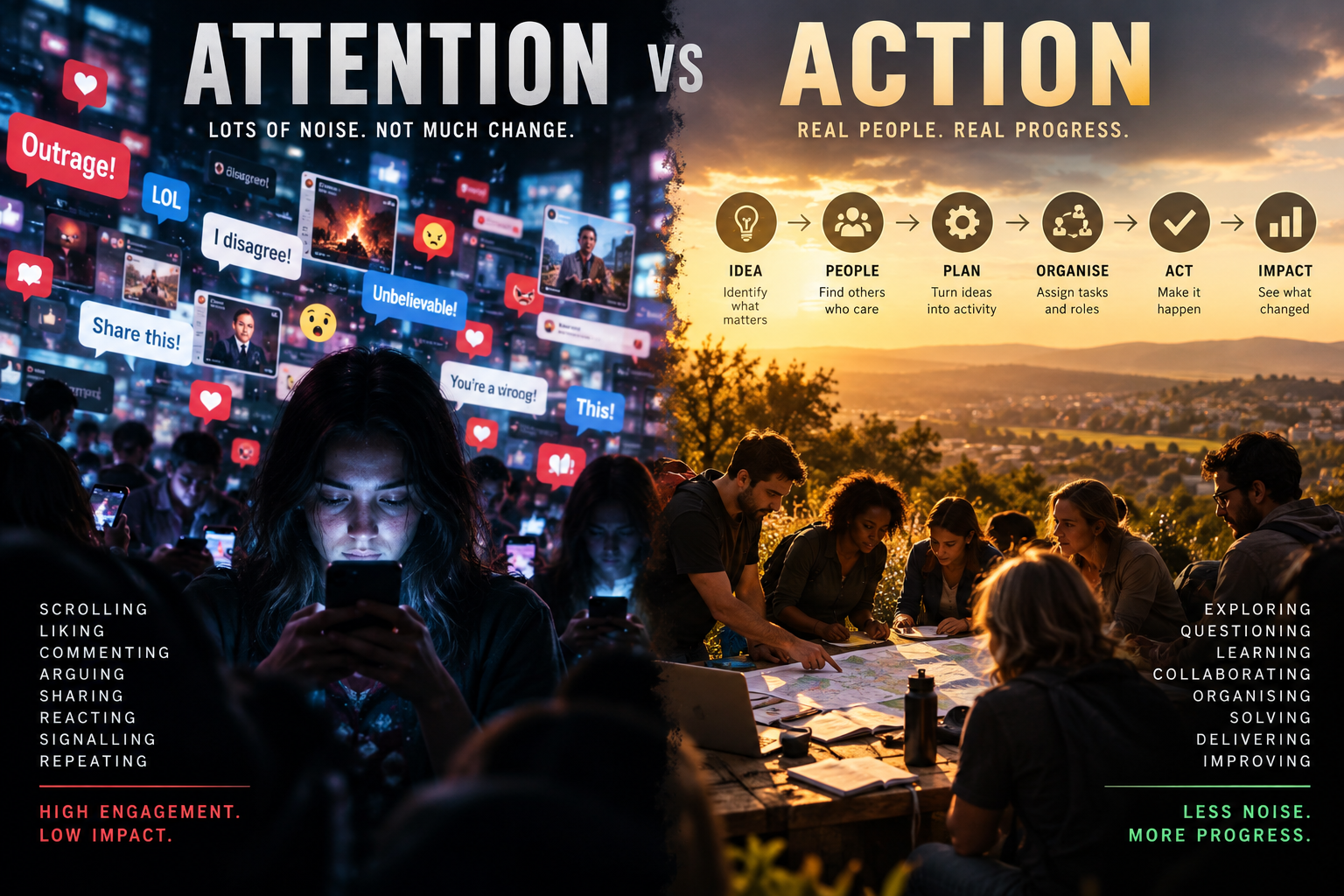
The internet did something extraordinary.
It gave billions of human beings a voice.
For most of history, the ability to communicate at scale belonged to a relatively small number of people and institutions. Governments. Newspapers. Broadcasters. Publishers. Universities. Religious organisations. Large companies.
Then the barriers collapsed.
Today, almost anyone with a phone can publish an opinion, expose a problem, challenge an assumption, share an idea, criticise a government, promote a cause, teach something they know, tell millions of people what happened to them — or simply tell the world what they had for breakfast.
That is an astonishing expansion of human agency.
But there is a problem.
We became extraordinarily good at speaking without becoming equally good at doing.
Umberto Eco Saw Part of the Problem
In 2015, Italian philosopher and novelist Umberto Eco caused controversy when he criticised the way social media could give uninformed voices the same apparent prominence as people who had spent decades developing genuine expertise.
His language was deliberately provocative.
But underneath it was an important observation.
The internet had flattened many of the traditional distinctions between knowledge, expertise, opinion and speculation.
On a screen, they could all look remarkably similar.
An expert could spend thirty years studying something.
Someone else could discover it yesterday.
Both could publish a post today.
And increasingly, algorithms weren’t required to determine which contribution was most knowledgeable, useful or accurate.
They discovered something much simpler.
Attention could be measured.
And attention could be monetised.
So the digital environment gradually became very good at generating more of whatever kept us looking.
Outrage.
Fear.
Conflict.
Certainty.
Tribalism.
Controversy.
Emotion.
None of those things is inherently wrong.
But there is another question we don’t ask nearly enough.
What actually happened afterwards?
Welcome to the Age of Performative Waste
Every day, extraordinary amounts of human energy are poured into the digital world.
We post.
Comment.
Like.
Share.
Argue.
Condemn.
Defend.
Campaign.
React.
Debunk.
Complain.
Explain.
Analyse.
Signal our support.
Signal our opposition.
Tell everyone what somebody else has done wrong.
Tell everyone what somebody else should do.
Then tomorrow arrives.
And we do it again.
Millions of intelligent, concerned, capable human beings collectively expend billions of hours expressing themselves.
Yet how much of that energy becomes organised action?
How much actually improves the condition that caused the discussion?
That is what we might call performative waste.
Not because speaking is pointless.
Speaking can be incredibly important.
Awareness matters.
Protest matters.
Debate matters.
Journalism matters.
Expertise matters.
Emotion matters.
Even anger can matter.
The waste occurs when expression becomes the destination rather than part of a journey.
We confuse visibility with progress.
Engagement with participation.
Followers with capability.
Virality with importance.
Agreement with commitment.
And sometimes argument with action.
The performance happened.
The underlying condition remained.
Perhaps We Have Been Measuring the Wrong Things
Much of the digital world measures what is easy to count.
Views.
Likes.
Comments.
Shares.
Followers.
Impressions.
Clicks.
Engagement.
Reach.
But imagine applying those measurements to almost anything important in ordinary life.
You discover that your local park is unsafe.
Ten thousand people view your post about it.
Success?
A company has a dysfunctional process.
Five hundred employees agree privately that it is ridiculous.
Success?
Someone has an idea that could improve their community.
Two thousand people like it.
Success?
A major social problem generates millions of angry posts.
Success?
Clearly not.
Something else has to happen.
And that suggests a completely different measure.
Did the condition improve?
Moving From Voice to Agency
The internet gave us voice.
Perhaps its next evolution needs to help us exercise agency.
Agency begins when somebody can move beyond:
“This is what I think.”
towards:
“This is what matters, and I am prepared to do something about it.”
That doesn’t mean everybody needs to become an activist.
It doesn’t mean everyone must lead.
And it certainly doesn’t mean everyone needs expertise in everything.
Quite the opposite.
A functioning participatory environment should allow people to contribute according to what they actually have to offer.
One person may experience the problem.
Another may understand it technically.
Someone else may challenge the assumptions surrounding it.
Another may know how to communicate it.
Someone may have an idea.
Someone else may improve that idea.
An expert may explain why part of it won’t work.
Someone affected by the issue may explain something the expert hadn’t considered.
Another person may have useful contacts.
Someone else may organise the work.
Some may contribute money.
Others may contribute time.
Many may simply say:
“Yes. This matters to me too.”
That is not a weakness.
That is distributed human capability.
We Don’t Need Everyone to Be an Expert
This is perhaps where we can rise above one of the problems Eco identified.
The answer isn’t to silence people who know less.
Nor is it to pretend that everybody knows the same amount.
It is to create environments where different forms of contribution can find their appropriate place.
Expertise should matter where expertise is required.
Evidence should matter where claims are being made.
Lived experience should matter where people are affected.
Questions should be welcomed where knowledge is absent.
Ideas should be tested rather than worshipped.
Assumptions should be challenged.
Disagreement should improve thinking rather than automatically create enemies.
And ultimately, ideas should encounter reality.
Because reality provides a particularly useful test.
Did it work?
The Missing Infrastructure
We already possess extraordinary infrastructure for communication.
We have platforms for publishing.
Platforms for messaging.
Platforms for video.
Platforms for professional networking.
Platforms for petitions.
Platforms for fundraising.
Platforms for project management.
Platforms for discussion.
Platforms for almost every conceivable form of digital interaction.
Yet something remains strangely difficult.
Imagine that you simply say:
“This condition matters to me. Who else wants to improve it?”
Where do you go?
How do you discover the people who agree?
How do you separate casual approval from genuine willingness to participate?
How do you bring together people with different capabilities?
How do you turn concern into an activity?
How do you develop the idea?
How do you organise people?
How do you decide what needs doing?
How do you allocate responsibility?
How do you know whether anything actually happened?
And how do you retain what was learned so the next group doesn’t have to start from zero?
Those aren’t primarily communication problems.
They are coordination problems.
From Attention to Intention
Imagine a different digital logic.
Instead of asking:
What will attract attention?
we begin with:
What are we trying to achieve?
Instead of:
How many people reacted?
we ask:
How many people are willing to participate?
Instead of:
Who won the argument?
we ask:
What did we learn?
Instead of:
Whose side are you on?
we ask:
What condition are we actually trying to improve?
Instead of:
What should somebody do about this?
we ask:
What can we do?
That is a profound change.
Attention becomes intention.
Intention becomes participation.
Participation becomes organisation.
Organisation becomes action.
Action produces outcomes.
And outcomes create learning.
Four Things We Can Actually Do
Much of what concerns us eventually comes down to a surprisingly understandable set of human intentions.
We can challenge assumptions.
We can make others aware.
We can stop what needs stopping.
And we can co-create new realities.
Sometimes the activity will be deeply personal.
Sometimes professional.
Sometimes local.
Sometimes organisational.
Sometimes societal.
Sometimes global.
And sometimes the most valuable contribution will simply be asking the question nobody else thought to ask.
The important thing is that the contribution has somewhere to go.
From Performance to Progress
This is the challenge.
Not eliminating social media.
Not eliminating disagreement.
Not deciding that experts should rule everyone else.
Not demanding that every conversation become a project.
And certainly not stopping people expressing themselves.
It is about creating an alternative pathway when people want to go further.
A pathway from:
concern → intention → activity → people → tasks → action → outcome.
Then expression has somewhere to lead.
The rant can reveal a problem.
The problem can generate a question.
The question can expose an assumption.
The assumption can provoke discussion.
The discussion can produce an idea.
The idea can become a solution.
The solution can attract people.
The people can organise.
And the organised group can act.
Suddenly those individual contributions aren’t competing for attention.
They are contributing towards something.
This Is Why Ideas-Shared Exists
Ideas-Shared starts from a simple proposition.
People should be able to decide what matters and voluntarily organise with others to do something about it.
Not everything requires a movement.
Not everything requires permission.
Not everything requires an institution.
Not everything requires a leader.
And not everyone needs to participate in the same way.
What is required is enough structure to turn human intention into collective capability.
That is why Ideas-Shared begins with ambitions and activities rather than feeds and followers.
An ambition establishes what somebody wants to achieve.
Activities allow people to explore, question, discuss, challenge, develop, request, offer, recommend, solve, organise and act around it.
People can then form teams.
Teams can agree tasks.
Tasks can be delivered.
And eventually we arrive somewhere far more meaningful than engagement.
An outcome.
Did something change?
Did something improve?
Did we learn something?
Did we solve the problem?
Did we achieve what we set out to achieve?
If not, what do we do next?
That is progress as a process rather than a performance.
The Internet Gave Us the Microphone
That may ultimately be the extraordinary contradiction of our digital age.
Humanity has never possessed greater capacity to communicate.
Never had greater access to information.
Never been able to find one another so easily.
Never possessed such powerful tools.
And yet we can still feel remarkably powerless.
Perhaps part of the reason is simple.
We built extraordinary infrastructure for expression without building equivalent infrastructure for collective agency.
So perhaps the answer to today’s digital dysfunction isn’t less human participation.
It is better organised human participation.
Let people speak.
Let people disagree.
Let experts contribute expertise.
Let people share lived experience.
Let somebody rant.
Let somebody ask the awkward question.
Let somebody challenge what everyone else assumes to be true.
Let somebody propose the seemingly impossible idea.
But when enough people eventually say:
“Something needs to change.”
we should have a better answer than:
Like. Comment. Share.
We should be able to say:
Then let’s organise and do something about it.
The internet gave nearly everyone a voice.
The next challenge is far more ambitious.
Can we turn billions of voices into billions of opportunities to make things better?