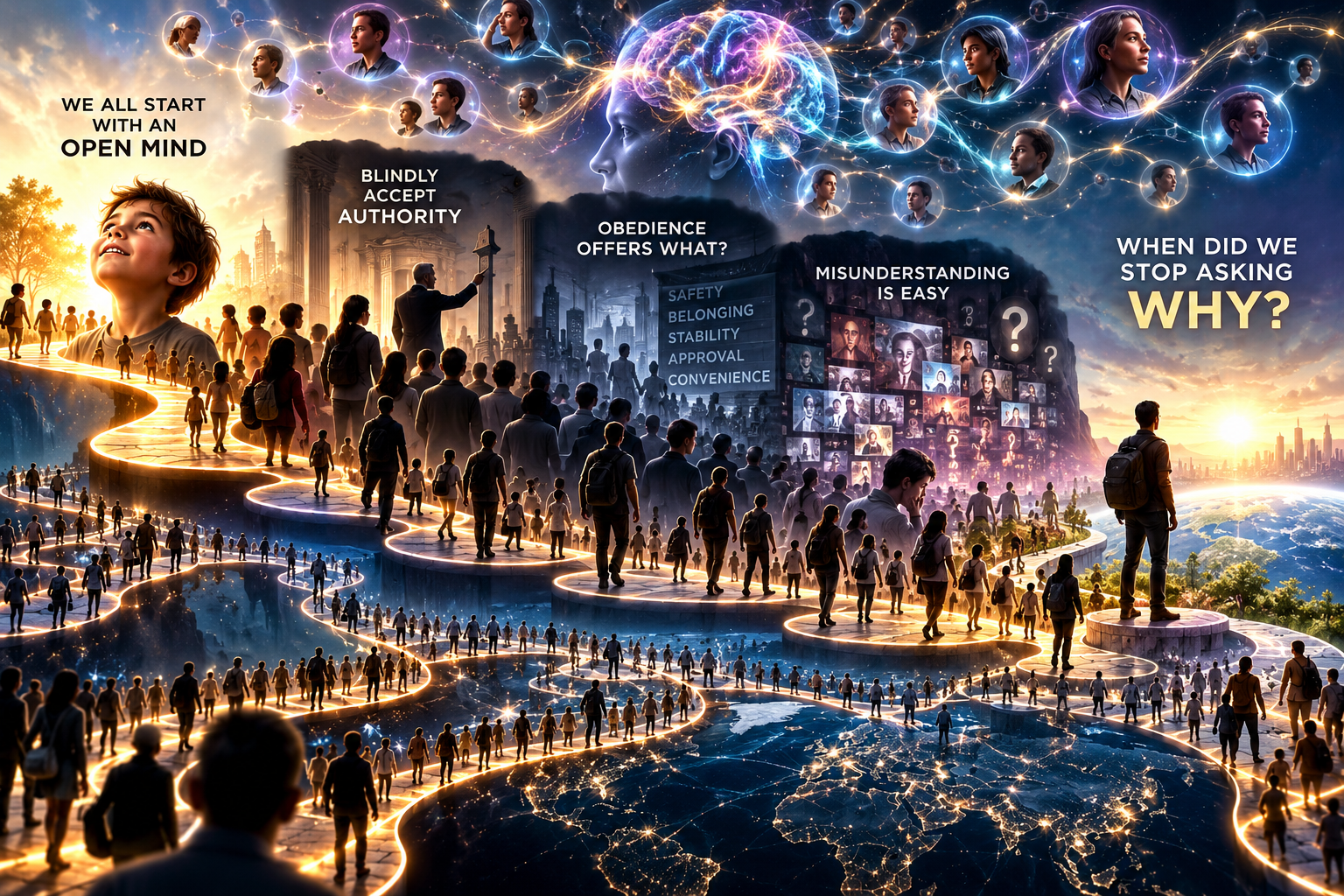
What if some of the greatest barriers to progress exist in our own thinking?
We begin life knowing very little.
We observe. We listen. We explore. We ask questions. We learn from the people and the world around us.
Everything is new. Everything is a discovery.
And then, gradually, something happens.
We begin accepting explanations. We inherit beliefs. We develop loyalties. We learn what is expected of us, what is considered normal, what is acceptable and what is not.
Our understanding of the world begins to take shape.
But how much of that understanding have we actually questioned?
We All Start Somewhere
None of us arrives in the world with a complete understanding of how it works.
Our families, communities, teachers, employers, institutions, governments and experiences all influence how we think.
Much of what we learn is valuable. Knowledge is passed between generations. Experience helps us avoid mistakes. Rules and institutions can provide stability, protection and opportunity.
But not everything we absorb is necessarily correct, complete or appropriate for every circumstance.
And therein lies a problem.
We can become so accustomed to what we believe that we forget to question why we believe it.
We may defend positions we’ve never properly examined, reject alternatives we’ve never considered or accept conditions we’ve never thought to challenge.
Not necessarily because we’re unwilling to think.
Sometimes because we’ve simply never been given a reason, opportunity or encouragement to think differently.
Blindly Accept Authority?
Authority is part of everyday life.
Parents, teachers, managers, experts, politicians, institutions and organisations all exercise different forms of authority.
Much of it serves legitimate and necessary purposes.
But authority and understanding are not the same thing.
Someone can hold a position of authority and still be mistaken. An established practice can be widely accepted and still need improvement. An institution can serve a valuable purpose while operating in ways that deserve examination.
So why do we sometimes treat questioning authority as a problem rather than an opportunity?
Respecting authority does not require surrendering independent judgement.
And challenging an assumption does not automatically mean rejecting the person, organisation or institution behind it.
It might simply mean asking whether there is a better way.
Obedience Offers What?
Security? Stability? Belonging? Approval? Convenience?
Sometimes obedience protects people, enables cooperation and makes collective activity possible.
But what happens when obedience becomes automatic?
When following instructions replaces understanding their purpose?
When established practices continue because that’s how things have always been done?
When people recognise problems but feel unable, unwilling or powerless to question them?
Consider how often we encounter circumstances that affect our lives, work, communities and wider society.
We might disagree with what is happening. We might see opportunities for improvement. We might even know people who feel exactly the same.
Yet nothing changes.
Why?
Perhaps we assume someone else is responsible.
Perhaps we believe we have no influence.
Perhaps we think the problem is too big, the system too established or the alternative too difficult.
But what if those assumptions are themselves part of what prevents progress?
Misunderstanding Is Easy
We all misunderstand things.
We misunderstand intentions, circumstances, information, motives, possibilities and one another.
We hear a statement and interpret it through our own experiences.
We encounter an unfamiliar idea and compare it with something we already know.
We see a disagreement and assume one side must be right and the other wrong.
We sometimes confuse confidence with knowledge, popularity with truth, and familiarity with understanding.
And increasingly, we encounter enormous volumes of information competing for our attention.
But information alone does not create understanding.
Nor does repeating something make it true.
Understanding requires curiosity, effort, evidence, conversation and a willingness to reconsider.
And perhaps the most difficult place to begin is with ourselves.
What If We Questioned Our Own Assumptions First?
Imagine approaching a disagreement differently.
Instead of immediately defending what we believe, we ask why we believe it.
Instead of assuming someone else is wrong, we explore how they arrived at their conclusion.
Instead of asking only what needs to change, we consider what could change, what we might do, and where else we might need to look.
We might discover that our original understanding was correct.
We might discover that it was incomplete.
Or we might uncover possibilities neither side had previously considered.
Questioning our assumptions doesn’t mean abandoning our values, accepting every opinion or agreeing with everyone.
It means recognising that none of us has a monopoly on understanding.
And that includes the people and institutions we trust, the people we disagree with, and ourselves.
An open mind is not an empty mind. It is a mind willing to keep learning.
Now Imagine Everyone Doing the Same
Not just a handful of people.
Not just politicians, academics, business leaders, campaigners or experts.
Everyone.
Individuals. Families. Communities. Informal groups. Businesses. Charities. Institutions. Governments.
Billions of people, each with their own experiences, knowledge, concerns, ideas, questions and ambitions.
Imagine more of us becoming willing to question our own assumptions, listen to others, explore alternatives and reconsider what might be possible.
Not because we must agree.
Not because someone has instructed us to think differently.
But because we recognise the value of understanding more than we currently do.
Now imagine what might happen when those individual discoveries begin connecting.
A question leads to a conversation.
A conversation reveals a shared concern.
A shared concern becomes an ambition.
An ambition brings people together.
And those people begin taking practical steps towards something better.
Some outcomes might improve a single life.
Others could transform organisations, communities or entire societies.
We cannot know what becomes possible until we give ourselves and one another the opportunity to explore it.
From Questioning to Doing
This is part of the thinking behind Ideas-Shared.
We believe everyone should have the opportunity to decide what matters to them, make their ambitions visible, discover others, participate voluntarily and take practical steps towards meaningful outcomes.
Our approach is built around four intentions:
- Challenge Assumptions — including our own.
- Make Others Aware — share what matters, what we know and what deserves attention.
- Stop What Needs Stopping — identify and address conditions, practices and activities that should not continue.
- Co-Create New Realities — bring people, knowledge, capabilities and resources together to make better possibilities real.
These are not instructions about what to believe.
They are invitations to think, explore, contribute and act.
And nobody needs to wait for thousands of others to begin.
One person can ask a question.
One person can identify an opportunity.
One person can invite another.
And together, they can begin.
Perhaps It’s Time to Ask Why Again
Why do we believe what we believe?
Why do we accept what we accept?
Why do we do things the way we do?
What might we have misunderstood?
What else could be possible?
And what might happen if we explored those questions together?
We won’t always agree. We won’t always find immediate answers. And we won’t always get things right.
But we can learn. We can reconsider. We can improve.
Perhaps the greatest change we can make isn’t changing what other people think. It’s becoming willing to reconsider what we think ourselves.
And perhaps that’s where a very different future begins.
Ideas-Shared — Changing the way people come together to get things done.
Explore what’s possible at Ideas-Shared
Challenge Assumptions. Make Others Aware. Stop What Needs Stopping. Co-Create New Realities.